

FDA User Fee Reauthorization: What Stakeholders Need to Know Now
The Food and Drug Administration (FDA) human medical product user fee programs, covering prescription drugs (PDUFA), medical devices (MDUFA), generic drugs (GDUFA) and biosimilars (BsUFA), are currently authorized through the end of September 2027. However, FDA–industry negotiations for the next reauthorization are well underway. Because user fee reauthorizations are often legislative vehicles for additional FDA policy, interested stakeholders, including medical product developers, patient groups, providers and nonprofit organizations, should pursue early engagement with Congress to advance their priorities. This alert provides background on the user fee reauthorization process and a timeline for what to expect.
Background: FDA User Fees and the Reauthorization Process
First enacted in 1992 as the Prescription Drug User Fee Act and reauthorized every five years since then, PDUFA authorizes the FDA to collect fees from companies that market or are seeking to market human prescription drugs and biological products. Likewise, MDUFA, GDUFA and BsUFA authorize the collection of fees for medical devices, generic drugs and biosimilar products, respectively. The fees collected are meant to augment appropriated funds out of the U.S. Treasury to support the review of product applications, inspections and other key agency functions. Over time, user fees have grown as a total percentage of the FDA’s budget, from roughly 20% of total FDA funding in 2007 to approximately 49% in 2025.
These user fee programs are currently authorized through Sept. 30, 2027. The process for the next reauthorization is mandated by law: the FDA and regulated industry are expected to negotiate a set of performance goals (e.g., review times for applications, topics and timelines for guidance documents on agreed-upon issues) and the amount of money required to achieve these goals. Based on this funding level, which is adjusted for inflation and workload over the five-year reauthorization period, a formula will set the fee amounts for each year. The FDA is also charged with consulting stakeholders like patients and providers for recommendations at least once each month during the negotiation process. At several points throughout the process, the FDA will brief key congressional committee staff on their progress. Not later than Jan. 15 of next year, the Department of Health and Human Services is required to submit recommended performance goals and the funding levels that result from these negotiations to the congressional committees with jurisdiction over the FDA—in the House, the Committee on Energy and Commerce, and in the Senate, the Committee on Health, Education, Labor and Pensions (HELP).
After the recommended performance goals are forwarded to Congress, committees review the agreement in context of prior reauthorizations and past performance by the FDA, often convening hearings with witnesses from FDA and industry to testify about the user fee program, drug and device reviews, and how they can improve.
When crafting reauthorization legislation, Congress typically adopts the recommended fees and performance goals with few, if any, modifications. Some members of Congress have raised concerns about the extent to which user fees fund the agency, arguing that the FDA is too dependent on funding from regulated industry. However, most have recognized that since the advent of user fees, the FDA has become significantly more productive, and without user fee funding, the FDA would be forced to lay off thousands of staff while dramatically slowing medical product reviews and other operations. Thus, the user fee reauthorization is viewed by most members as must-pass legislation.
Viewed through the lens of its must-pass status, the user fee reauthorizations are often legislative vehicles for other FDA-related reforms. For example, the Food and Drug Administration Amendments Act of 2007 (FDAAA) included significant reforms to the FDA’s post-market drug safety authorities and addressed food safety. The Food and Drug Administration Safety and Innovation Act (FDASIA), signed into law in 2012, created the “breakthrough therapy” designation to expedite drug development and review and modernized foreign inspections. In 2017, The Food and Drug Reauthorization Act (FDARA) created new incentives for generic drug competition and created a regulatory pathway for over-the-counter hearing aids. In September 2022, Congress enacted a largely clean user fee reauthorization after failing to come to agreement on the large policy reforms they were negotiating before the Sept. 30 deadline. However, later that year, congressional committees resolved their differences and enacted the Food and Drug Omnibus Reform Act (FDORA), which included a modernization of the accelerated approval pathway and the largest reform to cosmetics regulation in FDA history.
As these examples illustrate, policy riders on user fee bills often touch on areas beyond the user fee programs, and even beyond drug or medical device regulation. While Congress is often willing to consider a diverse array of FDA policy in a user fee bill, generally, they have not attached policies that go beyond FDA jurisdiction.
Across all prior reauthorization cycles, FDA user fee reauthorizations have been the product of bipartisan negotiations, regardless of the balance of power in Washington. While the midterm elections may alter the majorities in Congress—and members of different parties will certainly bring varied interests to the table—stakeholders are generally advised to pursue a bipartisan approach when seeking a legislative change through the user fee reauthorization process.
The Next Reauthorization: What to Expect and Tips for Engagement
The FDA kicked off the user fee negotiation process in the summer of 2025 with a series of public meetings for PDUFA, GDUFA and MDUFA. Negotiations with industry began later in the fall. As has historically been the case, activity around BsUFA has trailed the other programs; the FDA held a kickoff meeting in December 2025 and has not yet posted meeting minutes from any industry negotiations.
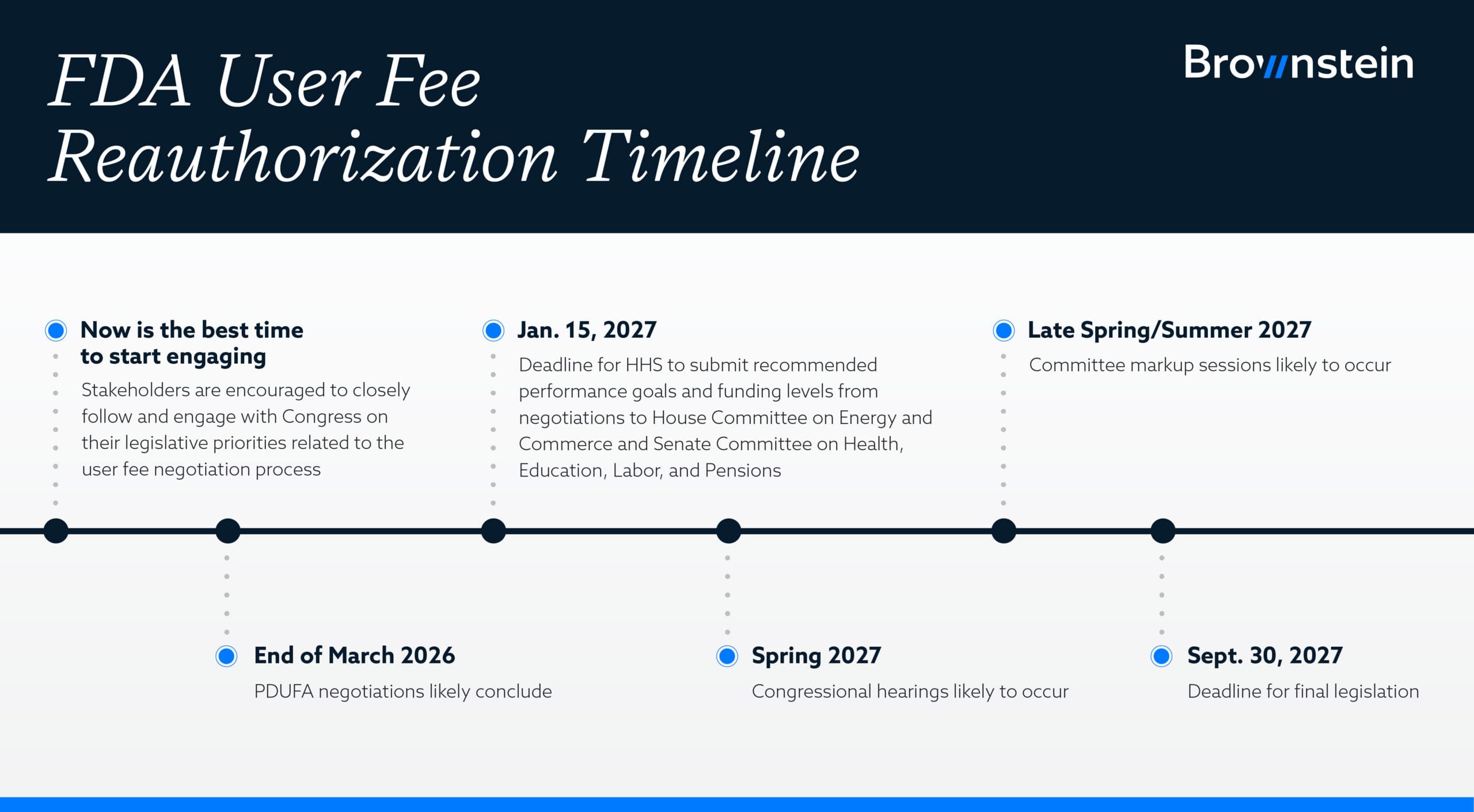
In addition to perennial issues of finances and staffing, topics discussed in negotiations have included proposals for new fee structures aimed at incentivizing domestic drug development in PDUFA and new domestic drug facilities in GDUFA. In MDUFA, FDA and industry have discussed an updated version of the Total Product Life Cycle Advisory Program (TAP) program. Negotiations are expected to conclude in the coming months, with PDUFA leading the pack, likely by the end of March, 2026. In the months after negotiations conclude, the FDA is required to publish draft recommendations in the Federal Register, provide a 30-day opportunity for public comment, and hold a public meeting at which members of the public may provide their views. The FDA may then revise their recommendations before formally transmitting them to Congress no later than Jan. 15, 2027.
Between now and next January, stakeholders are encouraged to closely follow the user fee negotiation process and engage with Congress on legislative priorities that may ride alongside a user fee reauthorization. Congress typically begins drafting a reauthorization bill soon after receiving the documents from the FDA. By spring 2027, committees will begin holding hearings and will have already begun negotiating key policy riders ahead of late-spring or early-summer committee markup sessions. The House and Senate will each try to move legislation and come together on a compromise bill no later than Sept. 30, 2027.
This timeline underscores the importance of stakeholders engaging with Congress as soon as possible—preferably in 2026. Stakeholders who have identified key champions in Congress and have circulated policy priorities among members of the committees of jurisdiction before hearings begin in spring 2027 will have the best shot at getting their policies included in final legislation. As they develop relationships on Capitol Hill, these stakeholders will also be in a key position to provide feedback to members of Congress on other aspects of the user fees, or push back on suggested policies that may not be in their best interest.
Next Steps
Brownstein will continue to follow user fee negotiations and is prepared to assist stakeholders with the development and execution of legislative and regulatory strategies. For additional insights into the user fee reauthorization process or assistance with engagement, please contact a member of the Brownstein team.