

Legislative Lowdown
House GOP Offers Repeal of Green-Energy Tax Credits and Expanded IRS Funding in Initial Debt-Ceiling Proposal. On Wednesday, April 19, House Republicans released the text of their proposal to avert the impending government default—the Limit, Save, Grow Act. The 320-page bill would raise the debt limit by $1.5 trillion or through March 2024, whichever comes first. Republicans estimate their package would also lower the federal deficit by $4.5 trillion over the next decade by modifying several tax incentives, rescinding unspent COVID-19 appropriations and imposing work requirements on certain federal entitlement programs.
A significant portion of the long-term reduction in spending is achieved through a proposed reversal of every green-energy tax provision of the Inflation Reduction Act (IRA). This would effectively reset the energy-incentive landscape to the pre-IRA regime. Although the proposal would leave certain legacy energy investment and biofuel/electricity production tax credits intact at lower amounts, it would allow them to expire in 2024 and 2022, respectively. The proposed blanket repeal is a nonstarter for Democrats and is expected to sew further uncertainty in the renewable-energy sector. Moreover, as a result of this proposal, a greater percentage of energy producers are expected to elect to receive one-time investment tax credits due to increasing doubt in the long-term viability of current annually calculated production-based incentives.
While Republicans were expected to target energy-tax credits perceived to be harmful to domestic manufacturing—such as the section 30D clean vehicle credit—the broad repeal was ultimately included at the insistence of particularly conservative lawmakers. In public comments last week, Sen. Chuck Grassley (R-IA) expressed concern over the proposed retroactive modifications of the biodiesel tax credit, telling reporters that in many cases, these credits are “already expended [and] you can’t get them back from [biodiesel producers].”
In conjunction with eliminating the current tax-incentive system, the bill would implement further energy reform by enacting Republicans’ Lower Energy Costs Act. The previously proposed bill is intended to strengthen the domestic energy supply chain through environmental permitting reform and new oil and gas leases, among other provisions.
Outside of energy reform, the GOP package would rescind most of the $80 billion in funding provided to the Internal Revenue Service (IRS) by the IRA. This repeal would include the entire unobligated amounts allocated for enforcement activities, operations support and the creation of a task force to study the feasibility of an IRS-run direct e-file option. However, the proposal would still allow the IRS access to $7.8 billion in IRA allocations for taxpayer services and business-systems modernization.
Republican Proposal Faces Internal Frustration and Outright Rejection from Democrats. The GOP debt-limit package is not expected to receive endorsement from any Democrats in its present form and will undoubtedly fail to amass sufficient support to pass in the current divided government. However, the proposal provides the House Republicans an opening stance in budget negotiations, which are expected to continue in the lead-up to the July or August “x date”—after which point the Treasury Department may not be able to fulfill all of the government’s obligations.
Last week, President Joe Biden addressed the GOP proposal during a public appearance at a union hall in Maryland. In his speech, Biden dismissed the bill as an unrealistic offer that threatens a default “unless [Biden] agree[s] to all these wacko notions [Republicans] have” to cut the federal budget in exchange for preventing a default. Senate Majority Leader Chuck Schumer (D-NY) mirrored this sentiment, affirming that the package would not be considered in the Democratic-controlled Senate. House Minority Leader Hakeem Jeffries (D-NY) also said that no Democrats would support the proposal.
On Thursday, House Speaker Kevin McCarthy (R-CA), Budget Committee Chairman Jodey Arrington (R-TX) and Ways and Means Committee Chairman Jason Smith (R-MO) met with some of the Republican conference’s ideological faction leaders about possible changes to the bill in order to get it through the lower chamber. Reps. Chip Roy (R-TX), Matt Gaetz (R-FL), Bob Good (R-VA) and Tim Burchett (R-TN) have said they would like to see more robust Medicaid and SNAP work requirements, while Reps. Andy Biggs (R-AZ) said the bill does not cut enough spending in the first year. Additionally, Reps. Nancy Mace (R-SC) and George Santos (R-NY) have indicated that they are leaning “no” on the bill because it includes work requirements for entitlement programs. Other reports have suggested that some midwestern House Republicans may reject the bill in its current form because it eliminates biofuel incentives—although these lawmakers already voted against the fuels-credit extensions during consideration of the IRA in November 2021.
Notwithstanding these grievances, House Republicans aim to hold a vote on their package sometime this week. When questioned about possible GOP objections to the legislation, McCarthy said that the effort was “in very good shape” and that House leadership was “working, talking through all the members.” If all Democrats oppose the package, Republicans can lose, at most, four votes and still pass the bill through the House of Representatives.
Lawmakers Introduce Business Tax-Incentive Extensions in Preparation for Potential Bipartisan Effort. Last week, bipartisan coalitions of House and Senate lawmakers introduced legislation to make permanent a pair of expired business incentives originally enacted in the Tax Cuts and Jobs Act (TCJA). While these standalone tax bills will not garner sufficient support to pass on their own, they may represent a renewed willingness by members to consider tax legislation in the 118th Congress.
The first effort concerns the recent shift in the calculation of the deduction for net business interest expenses under section 163(j). Through 2021, the deduction was limited to a maximum of 30% of a taxpayer’s earnings before interest, taxes, depreciation and amortization (EBITDA). Beginning in 2022, the provision reverted to allow taxpayers to deduct only net business interest expenses up to 30% of their earnings before interest and taxes (EBIT)—not taking into account depreciation or amortization. However, the new bills introduced last week, both titled the American Investment in Manufacturing Act, would retroactively restore the greater deduction allowance for tax years after 2021. In the Senate, the effort is led by Sens. Shelley Moore Capito (R-WV) and Kyrsten Sinema (I-AZ) and in the House by Reps. Adrian Smith (R-NE), Joe Morelle (D-NY), Kevin Hern (R-OK) and Brad Schneider (D-IL).
The second effort targets the recent expiration of a provision allowing businesses to immediately deduct research and development (R&D) costs. A proposal included in TCJA required businesses to begin amortizing section 174 R&D expenditures over five years after 2021. Before this, taxpayers could immediately deduct these expenditures, capitalize the expenses and amortize them over five years or elect a 10-year amortization of expenditures under the alternative minimum tax rules. The American Innovation and R&D Competitiveness Act, introduced in the House last week, would retroactively reverse the restrictions imposed by TCJA, again allowing taxpayers to immediately deduct any qualified R&D expenses incurred in tax years 2022 or later. The renewed effort is led by Reps. Ron Estes (R-KS) and John Larson (D-CT) and is co-sponsored in the House by 32 additional Democrats and 32 Republicans.
The recent R&D bill follows the introduction of a similar bill in the Senate last month that would restore full expensing under section 174, as well as significantly expand the section 41 payroll tax credit for small businesses that engage in qualified R&D activities. The Senate bill is led by Sens. Maggie Hassan (D-NH) and Todd Young (R-IN) and is co-sponsored by 20 other senators.
Despite this renewed optimism, standalone tax legislation is unlikely to move before lawmakers resolve the impending debt-ceiling issue. Even after that point, negotiations will be complicated by some Democratic lawmakers who may continue to insist on the inclusion of Child Tax Credit (CTC) and Low-Income Housing Tax Credit (LIHTC) reform before offering support for expansions of business incentives like the R&D tax credits and 163(j) deduction. Sen. Michael Bennet (D-CO), for example, recently stated his intention to “continue to oppose cutting taxes for corporations without passing an expanded CTC.”
However, House Ways and Means Committee Chairman Jason Smith (R-MO) has displayed a willingness to consider both CTC and LIHTC expansion legislation, creating a possible opening for a bipartisan deal with both business and individual tax provisions to materialize later in 2023.

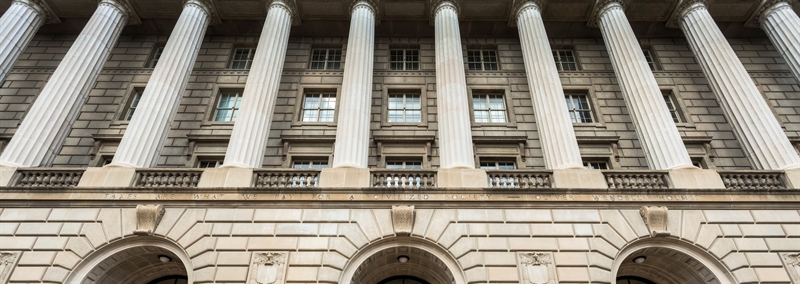
1111 Constitution Avenue
Werfel Testifies on IRS Budget, Leaves Some Senators’ Questions Unanswered. Last Wednesday, Internal Revenue Service (IRS) Commissioner Danny Werfel testified before the Senate Finance Committee on the Biden administration’s fiscal year 2024 budget request, as well as the IRS’ performance during the 2023 filing season. The hearing also focused on the IRS’ planned use of the $80 billion in additional funding provided by the Inflation Reduction Act (IRA).
Lawmakers questioned Werfel on myriad aspects of the IRS’ long-term Strategic Operating Plan (SOP), which was released on April 6. Despite ongoing calls for stronger IRS accountability, the SOP lacks significant, quantifiable success metrics for IRA-funded efforts. In his opening statement, Werfel said that the SOP purposefully does not answer every question in order to provide room for further improvements and cooperation with Congress. Moreover, he committed to providing the committee with a document in the next six weeks to supplement the SOP with “extensive details” on the IRS’ planned expenditures and hiring expectations across the entire 10-year budget period.
However, Werfel’s offer did little to quell concerns from some GOP senators, including Ranking Member Mike Crapo (R-ID), who said that the SOP “did nothing to flesh out the details” of the IRS’ plan for IRA funding. Sen. John Barrasso (R-WY) expressed similar discontent over the SOP, arguing that “despite the extra time [spent] to pull together the highly anticipated plan, it is lacking in measurable targets.”
Members of the committee probed Werfel for more details regarding taxpayer-enforcement objectives outlined in the SOP. Democratic lawmakers highlighted that the funding would be used to audit wealthy individuals and large corporations. Several Republicans requested more information regarding the IRS’ promise not to increase audits compared to historical levels for individuals with annual income below $400,000. Specifically, Sen. James Lankford (R-OK) raised further concerns over the IRS’ lack of clarification regarding the definition of the term “historic level,” to which Werfel suggested it would be based on the audit rates in tax years 2018 and 2019.
In addition to discussions over the SOP, Sen. Thom Tillis (R-NC) and Crapo raised concerns over the authority of the IRS to implement a free e-file system without congressional approval. The GOP senators also expressed skepticism regarding the ongoing free-file feasibility study and the “apparent bias” of New America—the think tank selected to conduct the study. In contrast, Senate Finance Committee Chairman Ron Wyden (D-OR) and Sen. Elizabeth Warren (D-MA) advocated for expanding efforts to pursue an IRS-operated filing system. In her questioning, Warren specifically argued that “tax prep companies have sabotaged the Free File program” and, as a result, have “trapped American taxpayers into paying for alternative services that should be free.” Responding to both groups, Werfel adopted a neutral stance and said that he “did not want to weigh in on the debate” and would wait until mid-May to analyze the final results of the feasibility study.
Senators also questioned Werfel on proposals to redirect a portion of the $45 billion allocated for enforcement to other agency priorities. Responding to a question from Sen. John Thune (R-SD) regarding efforts to reallocate funding to taxpayer services, Werfel said that he worried that if the IRS “were to redirect funds out of one basket into another, [the IRS] would lose important ground that [the agency] needs to cover in one particular area.” Last month, National Taxpayer Advocate Erin Collins recommended redistributing funding from the enforcement account to the operations, business-system-modernization and taxpayer-services accounts.
After the hearing, Sen. Todd Young (R-IN) said that the Senate Finance Committee should hold subsequent meetings with Werfel in the coming weeks to focus on the IRS’ plans for the IRA funding. In the meantime, the House Ways and Means Committee is scheduled to hold its first hearing with Werfel this Thursday. Committee Chairman Jason Smith (R-MO) and other GOP members are expected to raise similar concerns regarding enforcement, potential biases in the ongoing free e-file study and general data security gaps at the IRS.
At a Glance
House Republicans Target High Costs of Green-Energy Tax Incentives. On April 19, the House Ways and Means Committee held a hearing concerning the Inflation Reduction Act (IRA) renewable-energy tax credits. In the hearing, committee Chairman Jason Smith (R-MO) referenced recent private-sector reports estimating the cost of green-energy tax incentives to be significantly higher than official budget predictions. Smith also expressed concern that the tax credits would “overwhelmingly flow into the pockets of large financial institutions, more so than any other industry.” Republicans later noted that perceived loopholes in the section 30D clean vehicle credit might allow Chinese companies to profit from IRA tax subsidies intended to incentivize domestic manufacturing. Democratic lawmakers focused on the benefits of the IRA for rural and underserved communities.
Manchin Criticizes DOE’s Role in Green-Energy Tax Credit Implementation. At a Senate Committee on Energy and Natural Resources hearing last week, Secretary of Energy Jennifer Granholm testified on the Biden administration’s fiscal year 2024 budget request for the Department of Energy (DOE). In his opening statement, committee Chairman Joe Manchin (D-WV) expressed “concern that the DOE is asking for a more than 13% increase from 2023,” even though the agency received significant funding in recent legislation. Manchin also criticized the Biden administration for “liberalizing” congressional intent in its broad acceptance of free trade agreements under the section 30D clean vehicle credit. He further requested that Granholm “adhere to the law” when working with the Treasury Department and IRS to promulgate regulations related to the Inflation Reduction Act. Manchin also noted the Biden administration’s classification of certain materials that he believed unjustly allowed several additional vehicles to qualify for the section 30D credit.
Brown and Hassan Working on Bill to Raise 1099-K Reporting Requirements. Last week, Sen. Sherrod Brown (D-OH) told reporters that he is working with Sen. Maggie Hassan (D-NH) on legislation to increase the current 1099-K reporting threshold to $10,000. Brown said that he and Hassan “expect Republicans to join [them] on [the bill],” and although “some people want to do a different number, … $10,000 seems to be an agreed-upon number.” While the threshold was scheduled to be reduced to $600 in 2022, the IRS made a surprise announcement in January that it would delay all 1099-K modifications until 2023. Acting IRS Commissioner Doug O’Donnell said this decision was made to “reduce confusion during the 2023 tax filing season and provide more time for taxpayers to prepare and understand the new reporting requirements.
Brownstein Bookshelf
Progressive Lawmakers Propose Estate-Tax Expansion. On April 15, Sen. Bernie Sanders (I-VT) and Rep. Jimmy Gomez (D-CA) proposed the For the 99.5% Act, which would establish a new progressive estate-tax rate regime for individuals who inherit more than $3.5 million ($7 million for married couples).
Thune Introduces Legislation to Limit Subsidies for Auto Manufacturers. On April 20, Senate Minority Whip John Thune (R-SD) introduced legislation prohibiting electric-vehicle models from qualifying for the section 30D clean vehicle tax credit if manufacturers previously received funding from certain federal loans or grants.
Whistleblower Letter Sent to Tax-Committee Leadership Requests Additional Privacy Protection. On April 19, a lawyer representing an IRS criminal supervisory special agent sent a letter to the leadership of both the House and Senate tax-writing and Judiciary committees requesting additional protections for a whistleblower disclosure regarding improper handling of an investigation into Hunter Biden’s potential tax fraud.
Hearings and Events
House Ways and Means Committee
On Wednesday, the Subcommittee on Social Security will hold a hearing entitled “Social Security Fundamentals: A Fact-Based Foundation.” The following witnesses will testify:
- Barry Huston, Analyst Social Policy, Congressional Research Service
- Stephen Goss, Chief Actuary, Social Security Administration
- Phillip Swagel, Director, Congressional Budget Office
On Wednesday, the Subcommittee on Oversight will hold a hearing entitled “Tax-Exempt Hospitals and the Community Benefit Standard.” The following witnesses will testify:
- Jessica Lucas-Judy, Director, Strategic Issues, U.S. Government Accountability Office
- Ge Bai, Professor of Accounting and Health Policy, Johns Hopkins University
- Zachary Levinson, Project Director, KFF
- Melinda Reid Hatton, General Counsel, AHA Secretary, American Hospital Association
On Thursday, the full committee will hold a hearing entitled “Accountability and Transparency at the Internal Revenue Service.” The following witness will testify:
- Danny Werfel, Commissioner, Internal Revenue Service
Senate Finance Committee
The committee has no upcoming hearings scheduled for this week.
Private Sector
Wednesday, April 26
Ernst & Young
U.S. Corporate Income Tax
Peterson Institute for International Economics (PIIE)
Bank Supervision and Deposit Insurance After the Collapse of Silicon Valley Bank
Thursday, April 27
Brookings Institution
Powering a Clean Energy Future