

Legislative Lowdown
Congressional Tax Writers Solidify Opening Stances for Bipartisan Negotiations. Lawmakers returned to Capitol Hill yesterday to commence the final three-week legislative session before the upcoming August recess. After six months of the divided 118th Congress, members have remained unable to reach bipartisan consensus on any substantial tax legislation. Notwithstanding ongoing disagreements, the House and Senate tax-writing committees considered several tax proposals last month that could lay the groundwork for a significant compromise package later this year.
Republicans in the House Ways and Means Committee approved a trio of tax bills along party lines during a markup on June 13. The economic-growth package, which is comprised of the Tax Cuts for Working Families Act (H.R. 3936), the Small Business Jobs Act (H.R. 3937) and the Build It in America Act (H.R. 3938), was described by Chairman Jason Smith (R-MO) as a “tax relief and jobs package” shaped by “specific concerns” raised during the committee’s field hearings earlier this year. Among other provisions, the bills would reduce businesses’ tax liability by extending retroactively for tax years 2022 through 2025 three expiring incentives for research and development, interest expenses and certain new capital equipment.
Complicating House passage, several off-committee Republican lawmakers representing high-tax districts are withholding support for the package due to the absence of state and local tax (SALT) deduction relief. The group met with Chairman Smith last month to begin negotiations over an amendment to address their concerns, but that process may delay floor consideration until September. Rep. Nick LaLota (R-NY) commented on the impasse, noting that “right now it’s fair to say the [Republican] conference is pretty far apart on an accommodation on SALT.”
In the Senate, Sen. Sherrod Brown (D-OH) led the majority of the Democratic caucus in reintroducing the Working Families Tax Relief Act (S. 1992) on June 14. The bill would expand the child tax credit (CTC) significantly by permanently restoring the increased per-child credit value, full refundability and monthly advance payment option provided during the COVID-19 pandemic. Other provisions in the Democrats’ tax package would bolster the earned income tax credit (EITC), especially for taxpayers without qualifying children.
Despite overwhelming Democratic support, many Republicans have asserted that they would only support the restoration of pandemic-era tax credits if significant work requirements were enacted. During a Senate Finance Committee hearing last month, Sen. Thom Tillis (R-NC) expressed skepticism in “declaring [previous CTC expansions] to be highly successful with only five months of data.”
With the two parties’ policy priorities established, lawmakers may look to craft an agreement in the coming months that incorporates both business- and family-focused tax relief. Senate Majority Leader Chuck Schumer (D-NY) sent a Dear Colleague letter on Sunday highlighting Senate Democrats’ proposed legislative agenda for the upcoming July work period. While the letter does not explicitly reference tax legislation, Leader Schumer noted several bipartisan policy priorities—such as competition with China, agriculture and appropriations—that provide potential vehicles for myriad tax provisions.
Republicans Release Information Regarding Mishandling of Hunter Biden Tax Case. The House Ways and Means Committee voted along party lines on June 26 to release the public whistleblower testimonies of two IRS employees who worked directly on the tax evasion case of Hunter Biden. The committee met in a closed executive session to discuss testimonies alleging that the Biden administration Department of Justice (DOJ) and Delaware U.S. Attorney’s Office took deliberate action to sabotage the IRS investigation. While information regarding private citizens’ taxes is generally barred from public disclosure, section 6103 allowed the committee to release the investigative documents with a simple majority of committee support.
The first whistleblower, Special Supervisory Agent Gary Shapley, highlighted several instances in which U.S. Attorney for the District of Delaware David Weiss was denied special counsel authority by both the DOJ and the D.C. District Court throughout the investigation. In his testimony, Shapley remarked that the case had “been handled differently than any investigation [he had] ever been a part of for the past 14 years of [his] IRS service.” The second whistleblower, who elected to remain anonymous, corroborated elements of Shapley’s account and noted that the prosecutors had “honestly been appalling.”
Following the public release of the documents, GOP members noted their dissatisfaction with actions taken by the Biden administration IRS and DOJ. Chairman Jason Smith (R-MO) highlighted perceived “unequal enforcement of tax law, interference and government abuse in the handling of investigations into criminal activity by President Biden’s son.” Justifying his opposition to releasing the documents, Ranking Member Richard Neal (D-MA) said that the committee needed more time to conduct detailed investigations because he believed “[t]here’s no corroboration of any of [the whistleblower accounts].”
On July 5, Chairman Smith led a bicameral group of Republican lawmakers in a letter to Special Counsel Henry Kerner calling for “an immediate review of reported reprisal against investigators who raised concern about the Hunter Biden investigation.” In response to the ongoing investigation, IRS Commissioner Daniel Werfel sent a memo to IRS employees on July 7 informing them of their right to raise concerns about internal conduct to the appropriate authorities, including congressional oversight committees. Chairman Smith expressed support for the memo, reiterating that “[t]he IRS must be clear with its employees that they have a constitutional and statutory right to make protected disclosures to Congress. Period. Full stop."

Tax Worldview
Supreme Court to Hear Tax Case Concerning Unrealized Gains. The Supreme Court granted a writ of certiorari on June 26 to hear a case regarding the constitutionality of a tax enacted in the Tax Cuts and Jobs Act (TCJA, Pub. L. 115-97). The case, Moore v. United States, concerns the section 965 mandatory repatriation tax (MRT), which requires taxpayers to recognize the deferred tax on certain foreign income. The provision was intended to impose a one-time tax (which taxpayers can elect to pay over an eight-year period) on the accumulated earnings of foreign corporations with U.S. shareholders in the transition to TCJA’s quasi-territorial tax system that excludes many sources of foreign-earned income from U.S. taxation.
The plaintiffs, Charles and Kathleen Moore, assert that the MRT violates the Constitution’s Apportionment Clause, which requires that any “direct taxes” must be applied so that each state pays a portion commensurate with its population. While the Sixteenth Amendment allows for an exception with respect to direct taxes on income, the plaintiffs argue that the MRT is instead an unapportioned direct tax on unrealized gains that does not qualify under the exemption. The Moores contend that because they did not receive a distribution with respect to the corporation’s foreign earnings subject to the MRT, they did not realize such income directly, which they assert is required under the direct-taxes exemption. Furthermore, the Moores claim that the tax is applied retroactively, violating the Fifth Amendment’s Due Process Clause.
The District Court for the Western District of Washington previously granted the federal government’s motion to dismiss the case in 2020, and on appeal, the Ninth Circuit affirmed the lower court’s ruling. In the opinion, the court held that “realization of income is not a constitutional requirement” for taxation. Moreover, the court upheld the broad authority of the federal government to tax unrealized gains, finding that “there [is] no set definition of income under the Sixteenth Amendment,” and accordingly, “[w]hat constitutes a taxable gain is broadly construed.”
In arguments before the Supreme Court, both parties, as well as others submitting amicus briefs, are likely to question the constitutionality of taxes on unrealized gains beyond the context of the MRT. Depending on how narrowly or broadly the court rules, the decision could have broad ramifications for the tax code, potentially calling into question current-law tax rules that impute the realization of income by a business entity, such as a partnership or S corporation, to its owners. Additionally, the decision could affect existing rules that mark certain gains and losses to market (so-called “mark-to-market” regimes) if the court applies a strict realization standard. A strict standard could also question the viability of wealth-tax proposals, for example, that would mark-to-market unrealized gains of wealthy Americans.
The Supreme Court will hear the case in the upcoming term that begins in October, although a date has not yet been set for those oral arguments.
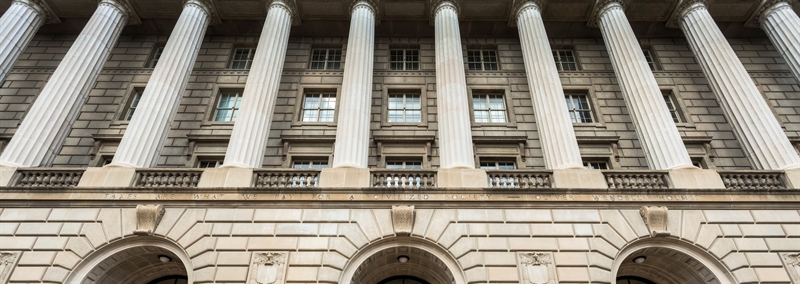
1111 Constitution Avenue
Stakeholders and Academics Question the Merits of IRS-Operated Filing Tool. As the IRS works to develop its new Direct e-File pilot program for the upcoming tax season, external groups have begun to weigh in on the prospective scope of the program. The creation of the pilot program follows the IRS’ Report to Congress in May evaluating the viability of an IRS-run tax preparation and electronic filing option for taxpayers. In conjunction with the report, the Treasury Department announced that it had directed the IRS to begin a “scaled” pilot project in 2024 that would allow the agency to prepare and file taxes on behalf of taxpayers.
A coalition of Democrats in the House and Senate sent a letter to IRS Commissioner Daniel Werfel and Treasury Deputy Secretary Wally Adeyemo on June 16 expressing support for expanding development of the new filing option. The letter was led by Sens. Elizabeth Warren (D-MA) and Tom Carper (D-DE), as well as Reps. Brad Sherman (D-CA), Katie Porter (D-CA) and Don Beyer (D-VA), and it was signed by an additional 34 Democratic senators and 60 Democratic representatives. No Republican signed onto the letter.
Notwithstanding the significant challenges in fielding a Direct e-File system noted in the IRS’s feasibility report, the letter suggested that “the report clearly shows an IRS direct file tool is a common-sense solution” to the current “broken system.” The lawmakers further requested that the IRS “make this pilot of the direct file tool available to as many taxpayers as is feasible” to demonstrate the value of modernizing the agency.
In opposition to ambitious appeals for a large-scale pilot, the congressionally chartered Electronic Tax Administration Advisory Committee (ETAAC) released its annual report on June 28 recommending that the IRS closely evaluate current free tax-filing programs before expanding investment into a new Direct e-File platform. ETAAC justified its hesitance toward the IRS-operated system by citing the tight development window of the pilot program and the up to $249 million in annual costs that would be attributed to the upkeep of a potential full-scale platform.
Instead, the report recommended that the IRS enhance existing taxpayer-assistance programs through increased marketing and expanded eligibility of the Volunteer Income Tax Assistance (VITA), Tax Counseling for the Elderly and Free File programs. Moreover, ETAAC asserted that supplemental funding provided to the agency by the Inflation Reduction Act (Pub. L. 117-169) should remain targeted toward other agencywide modernization and taxpayer-services priorities that will “impact a much broader swath of the taxpayer population and will have a more positive impact on effective tax administration” than the prospective Direct e-File platform.
The limited details offered regarding the upcoming pilot have left several fundamental questions unanswered, such as whether the platform will integrate with state returns or if earned income tax credit filing will be incorporated. More broadly, Republicans have raised concerns that the IRS does not possess the explicit authority to develop a Direct e-File system. Last week, Senate Finance Committee Ranking Member Mike Crapo (R-ID) suggested that the tool would create “an inherent conflict of interest” in which “taxpayers [could] never be sure they are being favored or disfavored” for using the platform.
House Appropriators Propose Significant IRS Funding Cut. The House Appropriations Subcommittee on Financial Services and General Government (FSGG) approved its eponymous spending bill on June 22 by voice vote, establishing Republicans’ proposed IRS funding levels for FY2024. The bill would provide $11.2 billion for the IRS and freeze spending for taxpayer services and operations support at FY2023 amounts, while imposing a significant $1.2 billion (23%) cut to tax enforcement appropriations. The bill would restore funding to the business-systems modernization account, providing $150 million to supplement the $4.75 billion in funding allocated for this task by the Inflation Reduction Act (IRA, Pub. L. 117-169).
Additionally, the proposed House FSGG bill would rescind approximately $10.2 billion of the supplemental funding provided to the IRS by the IRA. The bill proposes repealing $6.1 billion of the funding allocated specifically for enforcement and $4.1 billion of the funding allocated for operations support.
The bill offers a pair of new administrative provisions, including a section allowing the Treasury Secretary to utilize direct-hire authority until the end of FY2027 to fill agency positions for which there is a shortage of “highly qualified candidates.” Another new provision would prevent the IRS from using any FY2024 funding to develop or provide taxpayers with a “free, public electronic return-filing service option” without prior approval from both the House and Senate Appropriations committees and tax-writing committees.
The Senate Appropriations Committee will meet on Thursday to mark up its version of the bill. While the committee is yet to release statutory text, it adopted the top-line limits proposed by Chairwoman Patty Murray (D-WA) last month. The Senate spending caps adhere to the limits enacted in the Fiscal Responsibility Act (Pub. L. 118-15), although they are higher than the House proposals. Each chamber is likely to diverge significantly in the development of its FSGG legislation, especially with respect to the IRS, and a prospective final compromise will likely not emerge until much closer to the end of the fiscal year in September.
At a Glance
Senate (Finally) Approves Chile Tax Treaty. The Senate voted 95-2 on June 22 to approve a measure to ratify the tax treaty between the United States and Chile. The treaty is expected to increase investment by U.S. and Chilean companies by reducing applicable taxpayers’ withholding tax rates on dividends, interest and royalties. The treaty also addresses concerns regarding multinational corporations’ ability to engage in certain tax-avoidance transactions. Final passage was made possible after lawmakers addressed potential issues last year through reservation language included in the ratification measure clarifying that the treaty would not prevent the imposition of the U.S. base erosion and anti-abuse tax (BEAT). The treaty was negotiated and signed by the Obama administration in February 2010 but had been stalled pending Senate ratification for more than a decade.
Biden Reinforces Tax-Policy Priorities Through ‘Bidenomics’ Agenda. President Joe Biden gave remarks in Chicago, Illinois, on June 28 regarding his “Bidenomics” agenda, highlighting several elements of his upcoming tax-policy agenda for the 2024 presidential campaign. The speech largely criticized the 2017 Tax Cuts and Jobs Act (Pub. L. 115-97) as promoting “tax cuts for the wealthy.” President Biden reiterated many of the items noted in his 2020 campaign that were later listed in his annual “Greenbook Revenue Proposals” intended to increase taxes on large corporations and high-income taxpayers. One such item was the administration’s proposed “billionaire minimum tax” that President Biden said was necessary in light of the current “8% tax rate” paid by the wealthiest Americans. Referencing other specific policy proposals, President Biden noted that he intended to eliminate perceived tax “loopholes” used by “crypto traders, hedge-fund managers … and big oil.”
Brownstein Bookshelf
Stock Buyback Tax Reporting Relief. The Treasury Department and IRS issued Announcement 2023-18 on June 29, clarifying that taxpayers will not be required to report or pay the stock buyback excise tax until the agency issues forthcoming regulations later this year.
Treasury Reports Geographic Inequality in Opportunity-Zone Investments. The Treasury Department Office of Tax Analysis released a working paper on June 30 finding that over 95% of Opportunity Zone Program investment was directed toward urban census tracts in 2019 and 2020—highlighting significant shortfalls in the program’s support for rural areas.
Researchers Support Economic Viability of High-Income Tax Audits. Researchers from the Treasury Department, Harvard University and the University of Sydney issued a report remarking that each additional dollar spent on IRS enforcement targeting the wealthiest 10% of taxpayers yields an average of $12 in revenue, while audits of below-median-income taxpayers returned a comparatively low $5 for each additional dollar of audit resources expended.
Hearings and Events
House Ways and Means Committee
On Monday, the full committee held a field hearing in Kimball, Minnesota, entitled “Trade in America: Agriculture and Critical Supply Chains.” The following witnesses testified:
- Don Schiefelbein, Past President, National Cattlemen’s Beef Association
- Tom Bakk, Former Member, Minnesota State Legislature
- Carolyn Olson, Vice President, Minnesota Farm Bureau Board of Directors
- Brad Vold, Owner, Dorrich Dairy
- Gary Wertish, President, Minnesota Farmers Union
Senate Finance Committee
On Thursday, the Senate Finance Subcommittee on Taxation and IRS Oversight will hold a hearing entitled “Assessing 25 Years of the Child Tax Credit (1997-2022).” The following witnesses will testify:
- Katherine Michelmore, Associate Professor, Gerald R. Ford School of Public Policy, University of Michigan
- Indivar Dutta-Gupta, President and Executive Director, Center for Law and Social Policy
- Kevin Corinth, Senior Fellow, Deputy Director, Center on Opportunity and Social Mobility, American Enterprise Institute
- Angela Rachidi, Senior Fellow and Rowe Scholar, American Enterprise Institute
Senate Appropriations Committee
On Thursday, the Senate Appropriations Committee will hold a markup of several pieces of legislation, including the Financial Services and General Government Appropriations Act, 2024.