

Legislative Lowdown
Supreme Court Justices Signal Narrow Ruling in Repatriation Tax Case. On Dec. 5, the U.S. Supreme Court heard oral arguments in Moore v. United States, a case relating to the mandatory repatriation tax (MRT) from the Tax Cuts and Jobs Act (TCJA, Pub. L. 115-97). The MRT required U.S. citizens to pay a one-time repatriation tax on the earnings of foreign companies held by U.S. shareholders. The tax applies to earnings from controlled foreign corporations, even if they are distributed to U.S. shareholders. The provision was included in the TCJA as part of the transition from a worldwide to a quasi-territorial tax system for U.S. companies and their shareholders.
The case was initially filed by Charles and Kathleen Moore, who invested $40,000 in Indian farming supply company KisanKraft. Under the MRT, the Moores were required to pay $14,729 on a taxable income of $132,000. Andrew Grossman, who represents the Moores, argued that the couple should not have to pay the MRT since the income KisanKraft earned was not distributed to them and was instead reinvested in the company. Grossman argued, according to the 16th Amendment, income must result in a “gain” to the taxpayer, and since the Moores did not receive direct income from KisanKraft, there was no “gain” that should be subject to the tax. U.S. Solicitor General Elizabeth Prelogar argued that the 16th Amendment does not require income be realized in order to be taxed. She noted that unrealized income existed when the 16th Amendment was adopted, but was purposefully omitted from amendment text. She also argued the court has consistently upheld taxes applicable to income resulting from unrealized gains. She cited mark-to-market regimes and taxes on unrealized gains as far back as the 1860s.
During the case, the justices asked questions of both Grossman and Prelogar suggesting that they are concerned about the repercussions of issuing a broad ruling in the Moores’ favor that would either preclude all unrealized gains from taxation or give too much leeway to Congress to impose broader unrealized-gains taxes. Several justices pointed out that parts of the tax code—including taxation related to Subpart F, S corporations, partnerships, and taxation on an accrual basis—have historically been left to Congress to adjudicate. They suggested that a judicial ruling striking down all unrealized income from taxation may risk upending an array of existing structures and result in billions of dollars in lost revenue. However, Prelogar’s arguments received scrutiny from some of the justices, who said that allowing Congress to tax all unrealized income carte blanche may mean taxation imposed on Americans holding small amounts of stock, even in retirement investment accounts. Prelogar argued that Congress has never sought to impose such a ban and that federal taxes on property would constitute an unconstitutional “direct tax,” which may cover certain progressive wealth-tax proposals. By the end of the hearing, it appeared that the justices may rule in a more narrow manner and not seek to opine on the constitutionality of broader unrealized gains taxation proposals.
House Republicans Express Interest in Year-End Tax Deal. On Nov. 29, Rep. Rudy Yakym (R-IN) led a group of about 150 House Republicans in a letter to House Speaker Mike Johnson (R-LA), urging the House to consider restoring several expired tax provisions from the Tax Cuts and Jobs Act (TCJA). The letter specifically identified three TCJA-era provisions: immediate research and development (R&D) expensing, bonus depreciation, and restoration of a broader limit on interest deductibility. The letter asserts that restoring these provisions would incentivize economic growth, and that “failing to act quickly will jeopardize hundreds of thousands of American jobs.” Adding to the voices of support include a group of 1,000 small businesses, who sent a letter to the leadership of the Senate Finance and House Ways and Means committees urging Congress to renew the R&D expensing credit, stating that the expiration will “inadvertently stifle American innovation and compromise our nation’s leadership in science, technology, and innovation.”
The letters are the latest development in the potential year-end tax bill, which would include the three aforementioned TCJA provisions as well as a partial expansion of the Child Tax Credit. Congressional Democrats have noted that any package including the business provisions must be balanced with individual tax relief, namely modifications to the child tax credit, to secure their support. As of now, House Ways and Means Committee Chair Jason Smith (R-MO) and Senate Finance Committee Chair Ron Wyden (D-OR) are still in negotiations over the year-end tax bill, which is estimated to carry a price tag of roughly $95 billion.
Wyden Leads Bill Taxing High-Revenue and Asset-Rich Individuals. On Nov. 30, Senate Finance Committee Chair Ron Wyden (D-OR) introduced the Billionaires Income Tax Act (S. 3367), which would implement mark-to-market regimes and enforce greater taxation on taxpayers having more than $100 million in annual income or more than $1 billion in assets for three consecutive years. The bill aims to end the so-called “buy, borrow, die” method of tax avoidance that Chair Wyden has criticized on several occasions, including at a Finance Committee hearing last month.
The mark-to-market regime means that tradable assets gains will be taxed and deductions will be allowed on losses, regardless of whether the asset is sold or not, with taxpayers being allowed to carry back their losses for up to three years in certain circumstances. In addition, non-tradable asset sales would be subject to a “deferral recapture amount,” taxing the interest deferred while the individual held the asset. Upon introducing the bill, Sen. Wyden stated that the bill would ensure that “those at the very top start paying their fair share.”
The bill was published along with a press release, one-pager and section-by-section summary, and was co-sponsored by 15 other Democratic senators. A similar bill in the House, the Billionaire Minimum Income Tax (H.R. 6498), was introduced by Reps. Steve Cohen (D-TN) and Don Beyer (D-VA) on Nov. 29.
House Ways and Means Committee Advances Taiwan Tax Bill. On Nov. 30, the House Ways and Means Committee advanced several tax and trade bills, including a unanimous vote on the United States-Taiwan Expedited Double-Tax Relief Act (H.R. 5988). The bill would amend the Internal Revenue Code and provide substantial benefits to residents of Taiwan with income from sources within the United States, including reducing withholding tax rates, applying permanent establishment rules, and determining residency designations of citizens of Taiwan. In effect, the bill is intended to provide similar benefits to a U.S. tax treaty, which is not otherwise possible due to lack of formal diplomatic relations with Taiwan. One of the bill’s main intents is to incentivize Taiwanese companies to bring semiconductor chip manufacturing to the United States, countering China’s increasing dominance in the industry.
The bill includes a compromise plan that was jointly released by the Senate Finance and Foreign Relations committees, ending a jurisdictional battle between the committees over the Taiwan tax benefits. The bill combines elements of the two committees’ proposals, with their respective leadership indicating that they were “pleased” to have come up with an agreement that could be swiftly voted on by the Ways and Means Committee. The legislation’s future path toward enactment remains unclear, although the House is likely to advance the bill now that it has been favorably reported by the committee.

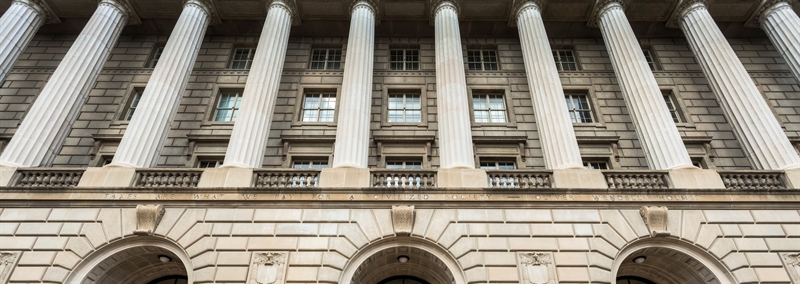
1111 Constitution Avenue
Tax Court Rules In IRS’ Favor on Limited Partnership Taxation. On Nov. 28, the U.S. Tax Court ruled that a “limited partner” label does not automatically exempt its founders from self-employment taxes on partnership-allocated earnings. The decision was closely watched by investment funds and other firms organized as limited partnerships, and Soroban Capital Partners LP, the petitioner in the case, still has the opportunity to appeal.
The bill will have a significant effect on partnership organization structures, as it may cause limited partners to renegotiate the terms of their partnership to reduce the amount of say they have in managerial decisions to reduce the risk of owing self-employment taxes. The ruling also supports the IRS’ increased scrutiny of partnerships and wealthy tax filers.
At a Glance
IRS Issues Guidance on Cash or Deferred Arrangements Under Section 401(k). On Nov. 27, the Internal Revenue Service (IRS) released a notice of proposed rulemaking that would amend the rules applicable to plans that include cash or deferred arrangements under section 401(k) to provide guidance with respect to long-term, part-time employees. The proposed regulation would affect participants in, beneficiaries of, employers maintaining, and administrators of plans that include cash or deferred arrangements. The notice also notes that a public hearing on the proposed regulation has been scheduled for March 15, 2024.
Treasury Department Issues More Guidance on Beneficial Ownership Reporting. In final rules issued by the Treasury Department’s Financial Crimes Enforcement Network (FinCEN) on Nov. 30, companies created or registered in 2024 will now have 90 calendar days after they are formed to report their “beneficial ownership” information to FinCEN. Under previous rules, companies only had 30 calendar days to report such information. The rule only applies to 2024; in 2025, the rule reverts back to the 30-day reporting deadline. This notice builds on new disclosure requirements issued by FinCEN intended to help law enforcement identify and scrutinize shell corporations suspected of aiding and abetting terrorism, drug trafficking and other global criminal activities.
Treasury Department, IRS Issue Guidance for Clean Vehicle Manufacturers. On Dec. 1, the Treasury Department and Internal Revenue Service (IRS) issued proposed regulations and a revenue procedure concerning the excluded entity restriction of the section 30D clean vehicle credit as amended by the Inflation Reduction Act (IRA, Pub. L. 117-169). This restriction prevents manufacturers from sourcing or utilizing materials from foreign entities of concern (FEOCs). The proposed regulations provide rules for determining whether applicable critical minerals (and their associated constituent materials) and battery components are FEOC-compliant. The revenue procedure provides procedural rules for qualified manufacturers of new clean vehicles to comply with the reporting, certification and attestation requirements regarding the excluded entity restriction.
Hearings and Events
House Ways and Means Committee
On Tuesday, the House Ways and Means Committee held an executive session titled “Hearing with the IRS Whistleblowers: Hunter Biden Investigation Obstruction in Their Own Words.”
On Wednesday, the House Ways and Means Committee will hold a hearing titled “Tax Policies to Expand Economic Growth and Increase Prosperity for American Families.”
Senate Finance Committee
The Senate Finance Committee has no tax hearings scheduled for this week.