

Legislative Lowdown
Tax-Writing Committees Unveil Tax Package Framework. On Jan. 16, House Ways and Means Committee Chairman Jason Smith (R-MO) and Senate Finance Committee Chairman Ron Wyden (D-OR) unveiled the framework for a $78 billion tax package, the product of months of negotiations between the two chairmen. The plan is titled The Tax Relief for American Families and Workers Act of 2024, and contains the following provisions.
- Business Tax Provisions: the package includes restorations of three business tax provisions included in the Tax Cuts and Jobs Act of 2017 (TCJA, Pub. L. 115-97) that began expiring after 2021:
- R&D Amortization: Through 2021, businesses were permitted to deduct immediately certain research and development (R&D) costs under section 174. Beginning in 2022, businesses would have to amortize R&D expenditures over five years. The package provision will delay the amortization date in which taxpayers must deduct R&D expenditures through tax year 2025.
- Accelerated Bonus Depreciation: Through 2022, businesses were able to claim 100% bonus depreciation under section 168(k) for eligible property placed in service during the taxable year. Starting in 2023, the bonus-depreciation allowance would decrease to 80%, the first 20% annual stepdown until bonus depreciation expires for equipment placed in service after 2026. The package provision will extend full bonus depreciation for property placed in service in tax years 2023, 2024 and 2025, retaining a 20% bonus depreciation rate for property placed in service in 2026, and phasing out in 2027.
- Business Interest Deduction Limitation: Through 2021, the deduction for net business interest expense under 163(j) was limited to a maximum of 30% of a taxpayer’s earnings before interest, taxes, depreciation and amortization (EBITDA). In 2022, the provision would have been narrowed to allow the 30% deduction based on only earnings before interest and taxes (EBIT)—no longer taking into account depreciation or amortization for purposes of the calculation. The package provision will extend the application of EBITDA through tax year 2025.
- Child Tax Credit Expansions: While Democrats have largely advocated for an expanded child tax credit (CTC), some were disappointed that the expansion was not as large as they hoped. Nevertheless, the package increases the amount of refundable CTC from $1,600 per child to $1,800 in tax year 2023, $1,900 in tax year 2024, and $2,000 in tax year 2025. The amount of CTC will also be tethered to inflation for tax years 2024 and 2025. The phase-in for the credit will be determined on a per-child basis, benefiting families with multiple children. Finally, a lookback provision for the CTC will be permitted, allowing families to elect to calculate their eligibility and the amount of the CTC based on their earned income from the prior tax year.
- Taiwan Double Tax Relief: The package includes the United States-Taiwan Expedited Double Tax Relief Act, which was marked up by the Ways and Means Committee in November. The bill is an equivalent to a tax treaty and provides relief for Taiwanese residents and businesses subject to U.S. taxation faced with double taxation. It also incentivizes Taiwanese manufacturing companies to bring operations to the United States, in critical industries like semiconductors.
- Disaster Tax Relief: The package includes tax relief covering certain disaster-related personal casualty losses and tax relief from wildfire damage compensation. The package also provides relief for losses related to the February 2023 train derailment in East Palestine, Ohio.
- Affordable Housing Credits: The package will restore the 12.5% ceiling for the Low-Income Housing Tax Credit (LIHTC) and will reduce the tax-exempt bond financing requirements for affordable housing buildings placed into service in 2024 or later.
- ERTC Regulation: As part of ongoing congressional oversight over the implementation of the Employee Retention Tax Credit (ERTC), the provision would prevent businesses from filing amended returns claiming ERTC claims for 2020 or 2021 after Jan. 31, 2024. The package also includes increased penalties on promotors who knowingly and fraudulently aided a taxpayer into falsely claiming the ERTC, as well as an extension of the statute of limitations for audits of ERTC claims from three to six years.
- Increase in 1099 Reporting Threshold: The package will increase the threshold for information reporting on Forms 1099-NEC and 1099-MISC from $600 to $1,000, and be adjusted for inflation.
Wyden praised the package, saying that the expansion of the CTC would “[help] so many kids get ahead” and that the housing credit reform would jumpstart the construction of affordable housing units. He also stated that the R&D provision plan would “sharpen our economic competitiveness with China and the rest of the world.” Smith stressed the package’s bipartisan nature, saying that “American families will benefit from this bipartisan agreement that provides greater tax relief, strengthens Main Street businesses, boosts our competitiveness with China, and creates jobs.” Senate Finance Committee Ranking Member Mike Crapo (R-ID) expressed willingness to consider and pass the package, saying that he will “continue working with … Senate colleagues to build broad, bipartisan support for a tax package that provides appropriate relief for working families and businesses.”
The next step for the package is expected to be a Ways and Means Committee markup late this week, with the aim of the House taking up the package under suspension of the rules after the House district work period next week. The process in the Senate is less clear, with some reports that Senate Majority Leader Chuck Schumer (D-NY) is supportive of processing the package in early February despite the opening of the filing season on Jan. 29. Congress, however, must also contend with passing supplemental funding legislation for the wars in Israel and Ukraine and a temporary government funding bill (discussed below) to avoid a government shutdown.
Congress Releases Funding Plan, Extending Deadlines of Laddered CR. On Jan. 14, House and Senate leadership released the bill text for a stopgap funding bill set to fund all government agencies until March. With the funding deadlines for four of the 12 appropriations bills set for Friday, Congress must pass, at a minimum, a partial funding bill or continuing resolution (CR) this week to avert a government shutdown. The new agreement, conditionally agreed upon by House Speaker Mike Johnson (R-LA) and Senate Majority Leader Chuck Schumer (D-NY), will fund Military Construction-VA, Agriculture-FDA, Transportation-HUD and Energy-Water until March 1, and the other eight appropriations bills, including funding for the Department of the Treasury and Internal Revenue Service, until March 8. This funding bill is designed to give Johnson and Schumer time to negotiate a longer-term spending bill, a decision that has been criticized by some Freedom Caucus Republicans as being too conciliatory toward Democrats. Despite vocal criticism from some members of the House Republican Conference urging Johnson to drop and renegotiate the bill, Johnson has chosen to press forward with his initial plan, as he stated that the CR is designed to deliver “meaningful policy wins and [a] better stewardship of American tax dollars” in the long-term.
Manchin Expresses Disapproval for EV Credit Implementation at Hearing. On Jan. 11, the Senate Energy and Natural Resources Committee held a hearing titled “Examining Federal Electric Vehicle Incentives Including the Federal Government’s Role in Fostering Reliable and Resilient Electric Vehicle Supply Chains,” in which Deputy Energy Secretary David Turk and Deputy Treasury Secretary Wally Adeyemo discussed electric vehicles (EVs) and EV infrastructure tax credits in the Inflation Reduction Act (IRA, Pub. L. 117-169), as well as the Treasury Department and Department of Energy’s (DOE) interpretation of the credits. In his opening statement, Committee Chair Joe Manchin (D-WV) criticized the agencies for misusing executive privilege to issue rulemakings that differ from what was directed in the Inflation Reduction Act (IRA). Examples he cited include cutting the percentage threshold in critical mineral sourcing requirements by half, proposing critical mineral free-trade agreements with countries suspected of having trade ties with China, and extending deadlines under which vehicle manufacturers must remove Chinese-sourced minerals and battery manufacturing processes from their supply chains.
Criticism of Biden’s DOE and Treasury’s actions is rare among Democrats, as other Democrats during the hearing largely approved of the agencies’ handling of execution of the IRA provisions, and stated that several of the provisions would incentivize domestic job creation and U.S. competitiveness with other countries that seek to control the EV production space, such as China.

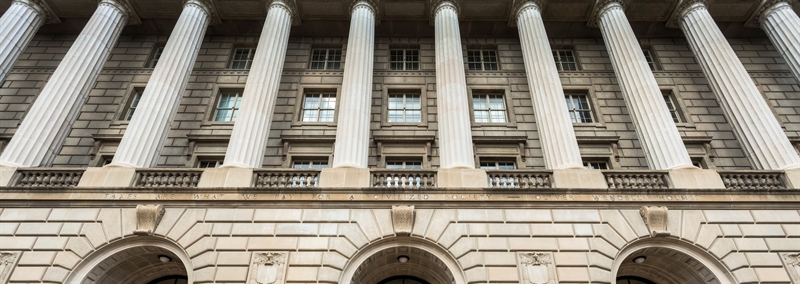
1111 Constitution Avenue
D.C. Bar Tax Conference Reveals Several Treasury Department and IRS Intentions. On Jan. 10 and 11, the D.C. Bar Association held its annual tax conference, in which several officials from the Department of the Treasury and the Internal Revenue Service (IRS) shared details on what guidance taxpayers can expect from the agencies in the coming tax year.
The panels covered a wide variety of topics, ranging from corporate and international tax provisions to legislative updates and guidance on domestic initiatives. One panel of Treasury Department officials opined on the Moore v. United States repatriation tax case, predicting that the Supreme Court would likely issue a narrow ruling in the case to prevent unintended consequence on other aspects of the tax code. Another panel remarked on the Organisation for Economic Co-Operation and Development (OECD) two-pillar international tax regime, with Treasury Department officials stating that they will not be renegotiating the terms of the Pillar One Amount A initiative, but have opened feedback solicitation channels to determine if “important issues” were missed in the initial guidance. Other takeaways from the two-day conference included IRS officials indicating that the agency would issue updated guidance on basis adjustments on previously taxed earnings and profits (PTEP) and on R&D amortization in the coming months, and that the agency will extend the safe harbor period with respect to the corporate alternative minimum tax (CAMT), with the massive guidance project expected to be released in the coming weeks.
For a full readout of the tax conference, please contact Daniel Joseph.
At a Glance
IRS Touts IRA-Funded Enforcement Efforts. In a press release on Jan. 12, the Internal Revenue Service (IRS) announced that the agency is continuing to expand enforcement efforts on high-income individuals and complex partnerships in an effort to collect outstanding tax debts from these taxpayers. The release expanded on the methods and practices the agency is utilizing, including scrutiny of balance sheet discrepancies, utilizing artificial intelligence, and examining improper usage of transfer pricing rules. The agency states that it has collected an additional $360 million in taxes owed since its last report in late October, bringing the total amount of owed taxes collected to $482 million from 1,600 wealthy taxpayers.
IRS Opens Free File Program for Taxpayer Use. On Jan. 12, the Internal Revenue Service (IRS) announced that interested taxpayers could begin using the IRS Free File Guided Tax Software service. The Free File program is a public-private partnership between the IRS and Free File Inc., which partners with private-sector tax preparation software companies to provide an option for taxpayers to file taxes for free. Eligibility for the Free File program will depend on criteria such as the taxpayer’s gross income and the forms they must file, which are set by the service providers. Though the program has opened for people to begin the process of filing their taxes, taxpayers will not be able to transmit their returns to the IRS until the agency begins accepting submissions on Jan. 29.
Brownstein Bookshelf
- National Taxpayer Advocate Releases Annual Report to Congress. On Jan. 10, National Taxpayer Advocate Erin Collins released the Taxpayer Advocate Service’s 2023 Annual Report to Congress, in which she identified problems with IRS processes that warrant attention and ways to improve tax administration. Among the problems Collins identified include continued paper processing delays and inadequate taxpayer service, as well as issues assisting taxpayers who are victims of identity theft.
Hearings and Events
House Ways and Means Committee
The House Ways and Means Committee has no tax hearings scheduled for this week.
Senate Finance Committee
The Senate Finance Committee has no tax hearings scheduled for this week.
Other
On Jan. 17, the Senate Budget Committee will hold a hearing titled “The Great Tax Escape: Closing Corporate Loopholes that Reward Offshoring Jobs and Profits.
On Jan. 17, the Supreme Court will hear two oral arguments, Loper Bright Enterprises v. Raimondo and Relentless, Inc. v. Department of Commerce, which may affect the ability of executive regulatory agencies like the IRS to possess statutory deferential authority over the interpretation of enacted legislation with ambiguous provisions.