

Legislative Lowdown
Budget Committee Document Detailing Potential Tax Bill Provisions Circulated: A leaked list of policy options purported to have been developed by the House Budget Committee details potential revenue and policy options for a 2025 tax bill. The document includes limited descriptions for proposals as well as budgetary estimates from a range of sources, in some cases with no source identified. The document contains several provisions that Republicans have discussed as potential provisions to include in tax legislation, including lowering the corporate tax rate from 21% to 15%, ending the Employee Retention Tax Credit, and repealing many of the clean energy tax credits in the Inflation Reduction Act (IRA, Pub. L. 117-169). However, the document previews other novel ideas that would modify or eliminate certain tax credits or deductions for individuals and businesses as a way to limit the revenue effects of the expected tax bill later this year. Stakeholders immediately pushed back against various portions of the document, although the list does not include any indication as to the viability of each proposal. Overall, the list appears to have been part of House leaders’ efforts to inform members, many of whom were not in Congress during the enactment of the Tax Cuts and Jobs Act of 2017 (Pub. L. 115-97), and illustrate the range of politically challenging revenue provisions that would be needed to offset some or all of the cost of extending or making permanent the expiring TCJA provisions, as well as new provisions President Donald Trump advocated for during his presidential campaign.
Senate Finance Committee Holds Bessent Nomination Hearing: On Thursday, Jan. 16, the Senate Finance Committee held a hearing titled “Hearing to Consider the Anticipated Nomination of Scott Bessent, of South Carolina, to be Secretary of the Treasury.” Committee members asked Bessent, the then-nominee-designate for secretary of the treasury, about several issues under the Treasury Department’s jurisdiction, including international tax issues, aspects of trade policy and regulation of financial institutions. Bessent was also asked about his views on the Tax Cuts and Jobs Act (TCJA, Pub. L. 115-97) and the Inflation Reduction Act (Pub. L. 117-169) and several of their provisions, with Bessent saying that not extending the TCJA would be “devastating” for American taxpayers and businesses. Overall, Bessent expressed approval for many of President Trump’s policy priorities, including his economic, tax and trade agenda, indicating that he would follow Trump’s lead as treasury secretary. His advocacy included a defense of Trump’s tariff policies, a desire to impose economic sanctions on Russia and opposition to the Organisation of Economic Co-operation and Development (OECD) Pillar Two tax regime (discussed below). However, he bucked Republican opposition to the IRS Direct File program, saying that he would keep it operational for the 2025 tax-filing season (discussed below). On Jan. 21, the Committee held an Executive Session to report Bessent’s nomination to the full Senate. His nomination was favorably reported 16-11, with Sens. Mark Warner (D-VA) and Maggie Hassan (D-NH) voting with all Republicans.
Ways and Means Committee Holds Hearing on TCJA Extension Considerations: On Jan. 14, the House Ways and Means Committee held its first policy hearing of the 119th Congress titled “The Need to Make Permanent the Trump Tax Cuts for Working Families.” The hearing discussed several expiring provisions of the Tax Cuts and Jobs Act (TCJA, Pub. L. 115-97) and whether they should be extended as part of a tax bill in 2025, including the Section 199A deduction for pass-through entities, the threshold increase for the estate tax, the doubled child tax credit and the full-and-immediate expensing of research and development costs for manufacturers. Republicans on the committee, including Chairman Jason Smith (R-MO), praised many of the TCJA’s provisions as providing economic stimulation following perceived “economic stagnation” through the Obama administration, saying that the TCJA contributed to higher worker salaries and lower unemployment and poverty rates. He also outlined numerous consequences of letting the TCJA expire for individuals of all income levels and businesses of all sizes. Meanwhile, committee Democrats, including Ranking Member Richard Neal, criticized the TCJA as disproportionately benefiting wealthy taxpayers and warned against passing an extension that would add to the national debt.
SALT Trade – Republicans Consider Limiting Business SALT Deduction in Exchange for Individual SALT Relief: Members of the House Freedom Caucus have proposed limiting the state and local tax (SALT) deduction for businesses in exchange for increasing the current limitation on individuals and families. House Republicans from high-tax states, informally known as the “SALT Caucus,” have criticized the SALT deduction limitation as uniquely disadvantageous to their constituents and have consulted with President Trump and House leadership on the possibility of raising or eliminating the limitation. The Freedom Caucus members’ proposal is the latest in a series of options to provide SALT relief for individuals. SALT advocates, however, have reportedly rejected the option, saying that they do not want to “trad[e] one blue-state penalty for another.” Neither the Freedom Caucus proposal nor the related leaked list of reconciliation options (see above) provide any detail as to the scope of business state and local taxes that would be included (e.g., income, property, special industry taxes) or any indication as to whether the deductibility of business SALT would be partially or fully denied.

Energy-Tax Mainlines
IRS Issues Additional Guidance Providing Safe Harbors for Section 45W Tax Credit: Supplementing proposed regulations to the Section 45W Qualified Commercial Clean Vehicles Credit issued Jan. 10, the Treasury Department and Internal Revenue Service (IRS) issued Notice 2025-09 on Jan. 15 providing safe harbor guidance for determining the incremental cost and retail price equivalent (RPE) of qualified commercial clean vehicles under Section 45W. Section 45W offers a tax credit for each qualified commercial clean vehicle placed in service during the taxable year. The credit is the lesser of (1) 30% of the taxpayer’s basis in the vehicle (15% for vehicles with internal combustion engines (ICE)) or (2) the incremental cost of the vehicle compared to a similar ICE vehicle.
For vehicles with a gross vehicle weight rating (GVWR) of less than 14,000 pounds, the maximum credit is $7,500. For heavier vehicles, the maximum credit is $40,000.
The safe harbors provide standardized methods for calculating incremental costs and determining eligibility for the Section 45W tax credit.
Incremental-Cost Safe Harbors:
- New Vehicles: Taxpayers may rely on the modeled incremental-cost figures in Table ES-2 of the Department of Energy’s (DOE) January 2025 Report for various vehicle classes. This safe harbor applies to vehicles placed in service on or after Jan. 1, 2025.
- Used Vehicles: For clean vehicles previously placed in service by another person or entity, taxpayers may use the incremental cost of the vehicle when new, adjusted by a residual value factor that corresponds to the vehicle’s age, as outlined in the newly proposed regulations under Section 45W. This method applies to vehicles placed in service after Dec. 31, 2022.
For model year 2023 vehicles, taxpayers may rely on predetermined safe harbor amounts provided in IRS Notice 2023-9 or use values published in the DOE December 2022 Report, and for model year 2024 vehicles, taxpayers may rely on IRS Notice 2024-5 or the DOE December 2023 Report.
RPE Safe Harbor:
For taxpayers electing not to use the incremental-cost safe harbors, the notice allows the use of RPEs provided in Table 4 of the DOE’s January 2025 Report. The RPEs enable taxpayers to calculate the incremental cost of qualified clean vehicles across various classes. The RPE safe harbor is applicable to vehicles placed in service after Dec. 31, 2022.
Treasury Department, IRS Issue Additional Guidance on Clean Energy Credit Domestic-Content Bonus Credits: On Jan. 20, the Treasury Department and Internal Revenue Service (IRS) released Notice 2025-08, providing additional guidance on the domestic-content bonus credits applicable to the Section 45Y Clean Electricity Production Credit and the Section 48E Clean Energy Investment Credit, both of which were enacted as part of the Inflation Reduction Act (Pub. L. 117-169). The notice builds on previous safe-harbor guidance with respect to the domestic-content requirements issued May 2024, which provides optional alternative cost percentages for developers of certain solar projects, as well as updates to clarify use of safe-harbor tables.
Treasury Department Releases Annual Table Listing Qualifying Technologies for Clean Electricity Tax Credits: On Jan. 15, the Treasury Department released the first Annual Table providing greenhouse gas emissions rate baselines for facilities eligible for the Section 45Y Clean Electricity Production Credit and the Section 48E Clean Energy Investment Credit. The Annual Table identifies geothermal, nuclear fission, nuclear fusion, wind, solar, hydropower, marine and hydrokinetic facilities, as well as certain waste energy recovery property facilities as qualifying non-combustion and gasification property qualifying for the clean-electricity credits.
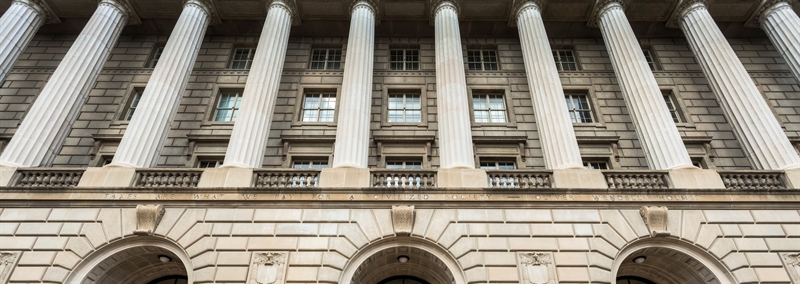
1111 Constitution Avenue
Werfel Resigns as IRS Commissioner: On Jan. 20, IRS Commissioner Daniel Werfel formally resigned as commissioner of the Internal Revenue Service (IRS) after announcing his intention to step down on Jan. 17. While he had previously said he was optimistic that he would continue to serve out the rest of his term under the Trump administration, Werfel later stated that he would resign “[a]fter significant introspection and consultation with others” and as an effort “to support a successful transition” from the Biden administration to the Trump administration. President Trump nominated former Rep. Billy Long to replace Werfel as IRS commissioner on Dec. 4, 2024. Werfel’s resignation marked the first time since 2007 that an IRS commissioner departed the agency before the end of their term.
Werfel served as IRS commissioner since March 2023, with his tenure marked by efforts to use Inflation Reduction Act (Pub. L. 117-169) funds to modernize the agency’s digital processes and increase enforcement efforts on high-income taxpayers, large corporations and complex partnerships. He also oversaw the administration of the Direct File pilot program, which is controversial among members of Congress and opposed by the commercial tax-preparation industry. Douglas O’Donnell will serve as acting commissioner of the Internal Revenue Service pending consideration of Long’s nomination.
Bessent to Keep Direct File Operational for 2025 Tax-Filing Season: At a Finance Committee hearing considering his anticipated nomination on Jan. 16, Treasury Secretary nominee-designate Scott Bessent said that, if confirmed, he would commit to keeping the Direct File program operational for the upcoming tax season and that “the American taxpayers who choose to use it, will.” He emphasized that, as treasury secretary, he would “study the program” to ensure it “serve[s] the IRS’s three goals of collections, customer service and privacy.” The question was asked by Senate Finance Committee Ranking Member Ron Wyden (D-OR), who chaired the committee during the last Congress and has been a strong proponent of the Direct File program throughout the administration of its pilot program during the previous filing season. Direct File still faces legal challenges over the IRS’ statutory authority to administer the program, and it remains unclear whether the program could be halted via a court order or other judicial means.
Tax Worldview
Trump Issues Memorandum Withdrawing U.S. Involvement from OECD Deal: On Jan. 20, President Trump issued a memorandum declaring that the two-pillar global tax deal negotiated by the Organisation for Economic Co-Operation and Development (OECD) will have “no force or effect in the United States.” Section 1 of the memorandum directs the Treasury Department secretary and permanent representative of the United States to the OECD to notify the OECD that commitments made by the Biden administration with respect to the deal will have no force or effect within the United States absent congressional adoption. Section 2 of the memorandum directs the Treasury Department secretary and United States Trade Representative to investigate whether foreign countries are not in compliance with U.S. tax treaties or put tax rules in place that “disproportionately affect American companies” and deliver findings and recommendations to the president within 60 days.
Bessent Would Reject Pillar Two of OECD Deal: At his Finance Committee nomination hearing on Jan. 16, Treasury Secretary nominee-designate Scott Bessent said that, if confirmed, the Trump administration may retaliate against countries enacting Pillar Two of the Organisation for Economic Co-operation and Development’s (OECD) global tax agreement. Sen. James Lankford (R-OK) asked Bessent if he would engage in international efforts to enact Pillar Two and what would happen if foreign jurisdictions tried to implement Pillar Two’s extraterritorial taxes against U.S. businesses, noting the difficulties the Finance Committee has had engaging former Treasury Secretary Janet Yellen regarding the Treasury Department’s authority to implement Pillar Two. Bessent replied that if any country imposes its Pillar Two regime on U.S. businesses, it would be making a “grave mistake.” He emphasized that the taxation of U.S. companies should remain a sovereign issue and that such authority lies with Congress. Bessent said that he will respect Congress’ statutory authority and work to undo a “terrible” Pillar Two policy developed by the Biden administration.
EU Tax Commissioner Pledges to Continue Seeking U.S. Engagement on International Tax Deal: On Jan. 14, European Union (EU) tax commissioner Wopke Hoekstra said that he would continue attempting to negotiate with the United States to finalize the Organisation for Economic Co-operation and Development (OECD) two-pillar global tax agreement. Hoekstra also noted that negotiations would help test the U.S. government’s “appetite” to reach a deal, although agreement is expected to be much more difficult under the Trump administration and a Republican-controlled Congress, which have been much more critical of the current agreement.
House Passes Taiwan Quasi-Tax Treaty Days After Reintroduction by Chairman Smith: On Jan. 15, the House of Representatives overwhelmingly passed the United States-Taiwan Expedited Double-Tax Relief Act (H.R. 33) by a vote of 423-1. Rep. Thomas Massie (R-KY) was the sole vote in opposition. The bill would establish a tax agreement between the United States and Taiwan that aims to mitigate double taxation for individuals and businesses operating in either country, with amendments to the U.S. tax code to provide treaty-like benefits. Specifically, the bill would provide reciprocal tax benefits for qualified residents of Taiwan and U.S. citizens subject to taxation in Taiwan, and provide adjustments to withholding tax rates, exemptions for qualified wages and rules for business income derived through permanent establishments.
The bill was introduced on Jan. 3 by House Ways and Committee Chairman Jason Smith (R-MO), who previously introduced identical legislation in the last Congress. The proposal was also part of the Tax Relief for American Families and Workers Act (H.R. 7024), which passed the House in January 2024 but stalled in the Senate for the remainder of the last Congress.
At a Glance
Treasury Department, IRS Issue Proposed Rules on Gain and Loss Recognitions in Corporate Transactions: On Jan. 13, the Treasury Department and Internal Revenue Service (IRS) issued proposed regulations concerning the nonrecognition of gains or losses in certain corporate separations, incorporations and reorganizations. The regulations provide that such transactions, if they meet the requirements of Section 355 of the Internal Revenue Code (i.e., spin-offs, split-offs, and split-ups), will be tax-free, provided certain reporting requirements are met in subsequent years. Public comments and hearing requests must be submitted through the Federal Register by March 17.
Treasury Department, IRS Issue Proposed Regulations on Executive Compensation Annual Deduction Limitation: On Jan. 14, the Treasury Department and Internal Revenue Service (IRS) issued proposed regulations concerning the federal taxation for certain employee remunerations exceeding $1 million, and the maximum allowable deduction allowed under Section 162(m) of the Internal Revenue Code. The American Rescue Plan Act (ARPA, Pub. L. 117-2) further expanded the categories of employees working for public corporations for whom deductions of compensation greater than $1 million are not allowed. ARPA added a new category that includes any employee who is among the five highest-paid employees. The new category is added to existing categories of executive officers such as the principal executive officer and principal financial officer. Thus, the new category would include common law nonexecutive employees. Public comments and hearing requests must be submitted through the Federal Register by March 17.
Moore Introduces Bill to Expand Child Tax Credit: On Jan. 13, Rep. Blake Moore (R-UT) introduced the Family First Act (H.R. 353), which would update and enhance the Child Tax Credit (CTC), building from the child tax credit increase in the Tax Cuts and Jobs Act (TCJA, Pub. L. 115-97). The bill would increase the maximum CTC amount to $4,200 for taxpayers with qualifying children ages 0–5 and $3,000 for taxpayers with qualifying children ages 6–17 and establish a new $2,800 tax credit for pregnant mothers. The bill’s cost is offset by cutting the value of the Earned Income Tax Credit for taxpayers with children, maintaining the $10,000 cap on the state and local tax (SALT) deduction, and eliminating the head of household filing status, the dependent portion of the personal exemption and the child and dependent care tax credit. The American Enterprise Institute has estimated that, under a current law baseline (assuming the expiration of TCJA individual provisions), the bill would generate $558 billion in revenues over the next 10 years. Under a current policy baseline (assuming the permanence of TCJA individual provisions), then the bill would cost $794 billion over 10 years.
Brownstein Bookshelf
Treasury Office of Tax Analysis Estimates Costs of TCJA Extensions: On Jan. 10, the Treasury Office of Tax Analysis released a report titled “The Cost and Distribution of Extending Expiring Provisions of the Tax Cuts and Jobs Act of 2017,” in which they found that the cost of a clean extension of the Tax Cuts and Jobs Act (Pub. L. 115-97) would be $4.2 trillion over the next 10 years, and additional adjustments to certain business tax measures would cost an additional $1.3 trillion. The report also states that an extension of the TCJA’s tax provisions only for taxpayers making under $400,000 annually would be $1.8 trillion.
CBO Report Provides 10-Year Economic Outlook, Revenue Effects of TCJA Expiration: On Jan. 17, the Congressional Budget Office (CBO) released a report titled ”The Budget and Economic Outlook:2025 to 2035,” in which the CBO estimated that the annual federal deficit would increase to $2.7 trillion by 2035, public debt would outpace GDP and economic growth would slow for the next two years before stabilizing. The report also notes that revenues would rise from 17.1% of GDP in 2025 to 18.2% of GDP by 2027 “in part because of the scheduled expiration of provisions” of the Tax Cuts and Jobs Act (Pub. L. 115-97).
Hearings and Events
House Ways and Means Committee
On Jan. 22, the House Ways and Means Committee held a hearing titled “Member Day Hearing on Matters Within the Committee’s Tax Jurisdiction.”
Senate Finance Committee
On Jan. 21, The Senate Finance Committee held an Executive Session considering the nomination of Scott Bessent to serve as Secretary of the Treasury.