

Legislative Lowdown
Senate Confirms Scott Bessent to Be Treasury Secretary: On Jan. 27, the Senate voted to confirm Scott Bessent to be secretary of the treasury by a vote of 68-29, with 15 Democrats and one independent senator voting with all present Republicans to confirm him. Bessent is expected to be a leading advocate and negotiator on many of President Trump’s economic policy priorities, including the president’s economic, tax and trade agenda.
Republican Leaders Meeting to Discuss Reconciliation Strategy: This week, the House Republican Conference is meeting in Florida to discuss strategy and attempt to come to an agreement on how to pursue their policy agenda through the reconciliation process, with House Speaker Mike Johnson (R-LA) indicating on Jan. 23 that he plans to finalize and present a “blueprint” for reconciliation. Alignment among the entire congressional Republican conference is key, given the party’s slim majorities in both chambers. Furthermore, House and Senate Republicans must ultimately adopt identical blueprints for the relevant committees to begin crafting a reconciliation bill to prevent the bill from being filibustered by Senate Democrats.
Government Funding Negotiations Begin: On Jan. 23, the leadership of the House and Senate Appropriations Committees—the so-called “four corners”—met to discuss a government funding bill in hopes of creating a bipartisan plan to fund the federal government before March 14 to avert a government shutdown. House Appropriations Committee Ranking Member Rosa DeLauro (D-CT) noted that the four corners are aiming to set a topline agreement by Jan. 31 for military and non-defense funding totals, as well as rules for policy add-ons.
Ways and Means Committee Holds Member Day Hearing: On Jan. 22, the House Ways and Means Committee held a Member Day hearing, allowing members to promote legislation before the committee. Congressional members advocated for bills that encompassed a wide array of tax-related issues.
Many Republican members advocated for the extension of various tax provisions in the Tax Cuts and Jobs Act (TCJA, Pub. L. 115-97), citing the tax increases that individuals and small businesses would face if the provisions expired. Among the most discussed TCJA provisions were the increased estate tax exemption threshold, the Section 199A passthrough business deduction and the restoration of full-and-immediate expensing for research and development activities. A number of members also testified in support of several energy-tax provisions in the Inflation Reduction Act (Pub. L. 117-169), most prominently the Section 45Z Clean Fuel Production Credit, the Section 45X Advanced Manufacturing Production Credit, and the Section 45Y and 48E Clean Electricity Credits. Members were divided on the state and local tax (SALT) deduction limitation, with some calling for removal or expansion of the credit, and others urging for no changes to be made. Other topics discussed at the Member Day hearing included housing, economic development, trade, tax credits for families and excise taxes.
Sen. Daines, Rep. Smucker Introduce Bill to Extend and Make Permanent the Section 199A Deduction: On Jan. 23, Sen. Steve Daines (R-MT) introduced the Main Street Tax Certainty Act (S. 213), which would make permanent the Tax Cuts and Jobs Act (TCJA, Pub. L. 115-97) provision that established the Section 199A 20% deduction for passthrough businesses. The deduction provides greater equivalence between the effective tax rates of passthrough businesses and C Corporations since the corporate rate was permanently lowered to 21% as part of the TCJA. If the Section 199A provision is allowed to expire, many passthrough businesses would be taxed at the individual level, with the top marginal individual income tax rate being 37%, rather than the 29.6% effective tax rate with the section 199A deduction. Sen. Daines’ bill is cosponsored by Senate Majority Leader John Thune (R-SD) and 38 other Senate Republicans. Companion legislation (H.R. 703) was introduced in the House by Rep. Lloyd Smucker (R-PA) and has 155 cosponsors, including Democratic Reps. Josh Gottheimer (D-NJ) and Henry Cuellar (D-TX).
Brownstein’s PROTECT Coalition has been advocating to Congress to preserve the Section 199A deduction, including through letters sent to members of Congress calling for support of the new legislation. To learn more about the PROTECT Coalition, please contact Russ Sullivan and Rosemary Becchi.
Senate Finance and Foreign Relations Committees Reintroduce Taiwan Quasi-Tax Treaty: On Jan. 23, Senate Finance Committee Chairman Mike Crapo (R-ID) and Ranking Member Ron Wyden (D-OR), along with Foreign Relations Committee Chairman Jim Risch (R-ID) and Ranking Member Jeanne Shaheen (D-NH), reintroduced legislation (S. 199) that would establish treaty-like tax benefits between the United States and Taiwan. The bill would call for a tax agreement between the United States and Taiwan that aims to mitigate double taxation for individuals and businesses operating in either country implemented by amendments to the U.S. tax code. Specifically, the bill would provide reciprocal tax benefits for qualified residents of Taiwan and U.S. citizens subject to taxation in Taiwan, and provide adjustments to withholding tax rates, exemptions for qualified wages and rules for business income derived through permanent establishments.
Companion legislation (H.R. 33), originally introduced by House Ways and Means Committee Chairman Jason Smith (R-MO), overwhelmingly passed the House on Jan. 15. The proposal was also part of the Tax Relief for American Families and Workers Act (H.R. 7024, 118th Congress), which passed the House in January 2024 but stalled in the Senate for the remainder of the last Congress.

Energy-Tax Mainlines
Trump Issues Several Executive Actions Concerning U.S. Energy Production and Funding Allocations: Shortly after taking office on Jan. 20, President Donald Trump issued multiple executive orders and memoranda, many of which relate to domestic energy production as well as disbursements of funds allocated through the Inflation Reduction Act (IRA, Pub. L. 117-169) and Infrastructure Investment and Jobs Act (IIJA, Pub. L. 117-58) tax credits, grants and loan programs. One of the most significant executive orders, titled “Unleashing American Energy,” calls for the immediate pause of the disbursement of IRA- and IIJA-appropriated funds until they are reviewed by department officials and a report on those findings is submitted to the directors of the National Economic Council and Office of Management and Budget. The pause affects all “processes, policies, and programs for issuing grants, loans, contracts, or any other financial disbursements of such appropriated funds.” The pause may affect IRA energy-tax credit allocations, though the scope of the executive order remains unclear as to the types of infrastructure and projects that are subject to the pause. If funding allocations are interrupted, the executive order could result in project delays, cancellations and other administrative and procedural challenges. The Office of Management and Budget issued a memorandum on Jan. 27 confirming that all federal financial assistance, including grants and loans governed by the executive order, would be paused starting on Jan. 28 at 5:00 p.m. ET. However, shortly before the memo took effect, U.S. District Judge Loren AliKhan granted an administrative stay in a case challenging the Trump administration’s attempt to pause federal aid, ordering the Trump administration not to block the disbursement of federal funds under any open awards until at least 5 p.m. ET on Feb. 3. OMB later rescinded its memo on Jan. 29, and it remains to be seen whether the Trump administration will attempt a different approach to enforcing the terms of this executive order.
Another executive order revokes 78 executive actions from the Biden administration, including those related to directing investment to environmentally and economically disadvantaged communities through initiatives like the Justice40 Initiatives and tools like the Climate & Economic Justice Screening Tool, which was removed by the Council of Environmental Quality when this executive order took effect. Finally, President Trump issued a memorandum imposing a regulatory freeze, pausing the issuance, publication and enforcement of new federal rules pending review by department or agency heads appointed by the new administration. More information about the effects of the regulatory freeze is discussed below.
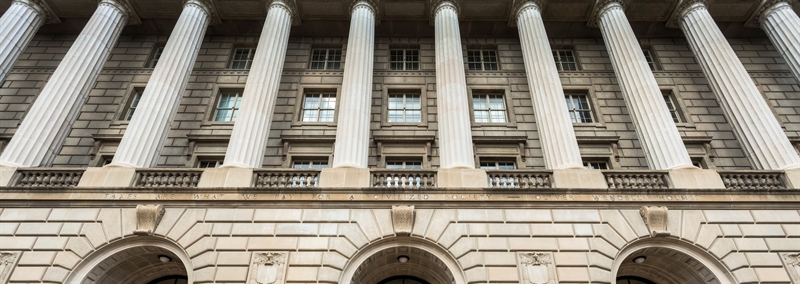
1111 Constitution Avenue
Trump Regulatory Freeze Memorandum May Affect Regulation Promulgation: On Jan. 20, President Trump issued a memorandum pausing the issuance, publication and enforcement of new federal rules and regulations pending review by department or agency heads appointed by the incoming administration. It instructs agencies to withdraw rules not yet published in the Federal Register and allows for a 60-day delay of recently published or issued rules that are not yet effective to allow the incoming administration time to evaluate the legal, factual and policy implications. The freeze will allow the Treasury Department and Internal Revenue Service (IRS) to scrutinize guidance that has not yet been finalized, as well as any guidance that was finalized in the final weeks of the Biden administration that “frustrate the purpose” of the regulatory freeze.
Trump Hiring Freeze Memorandum Affects IRS Hiring Timeline: On Jan. 20, President Trump issued a memorandum imposing a hiring freeze on all federal civilian employees under the executive branch, with the requirement that the director of the Office of Management and Budget (OMB) would submit within 90 days a plan to reduce the size of the workforce of the federal government “through efficiency improvements and attrition.” Upon issuance of the OMB’s plan, the hiring freeze would be lifted, with an exception for the Internal Revenue Service (IRS), where the hiring freeze would continue until the Treasury Department secretary, OMB director and the United States DOGE service director “determines that it is in the national interest to lift the freeze.”
Following the president’s announcement, the IRS noted on its jobs page that it would no longer be seeking employees, and that any job offers with a start date after Feb. 8, 2025, or with an unconfirmed start date would be rescinded. It is unclear whether the hiring freeze will impede the agency’s ability to maintain its level of taxpayer service during the 2025 tax-filing season. Although IRS employees hired to ensure smooth operations during the tax-filing season have likely already been onboarded, any IRS employees choosing to retire may not have their roles filled promptly, which could affect taxpayer service. Another presidential action mandating in-person service may be a factor in government employees’ decision to retire or seek other work, as the IRS currently employs many remote workers.
Supreme Court Lifts CTA Injunction, But FinCEN Confirms Filings Remain Optional: On Jan. 23, the United States Supreme Court granted the government’s motion in Texas Top Cop Shop, Inc. v. McHenry (formerly Texas Top Cop Shop, Inc. v. Garland) to stay a nationwide injunction blocking the implementation of the Corporate Transparency Act’s requirement to report beneficial ownership information (BOI) to the Financial Crimes Enforcement Network (FinCEN). However, FinCEN clarified on Jan. 24 that BOI reporting remains optional due to a separate, narrower nationwide injunction put in place by another court that was not affected by the Supreme Court’s action in Texas Top Cop Shop.
2025 Tax Filing Season Begins: On Jan. 27, the Internal Revenue Service (IRS) opened the 2025 tax-filing season for the processing of tax year 2024 returns. An accompanying press release notes that the agency expects 140 million tax year 2024 returns to be filed, and noted several options taxpayers could use to seek assistance with tax filing, as well as options for eligible taxpayers to file their federal tax returns for free.
Tax Worldview
Ways and Means Republicans Reintroduce Bill to Retaliate Against OECD Deal: On Jan. 22, House Ways and Means Committee Chairman Jason Smith (R-MO), joined by all committee Republicans, introduced the Defending American Jobs and Investment Act (H.R. 591). The bill is substantially similar to legislation the committee introduced in the last Congress and complements an executive order issued by President Donald Trump on Jan. 20 that withdraws the United States from the Organisation for Economic Co-operation and Development (OECD) global tax agreement. Republicans and some Democrats have been critical of the agreement, asserting that the Biden administration negotiated the deal without congressional consultation. Congressional critics also contend that the deal negotiated could lead to the loss of up to $120 billion in U.S. tax revenue, per an analysis by the Joint Committee on Taxation in the prior Congress.
The bill would require the Treasury Department to identify any discriminatory and “extraterritorial” taxes adopted by foreign jurisdictions that would adversely affect U.S. businesses, including the undertaxed profits rule (UTPR) included in the OECD’s Pillar Two global minimum tax. The bill would authorize the administration to retaliate by imposing a reciprocal tax increase of up to 20% on the U.S.-source income of individuals and businesses for those countries.
At a Glance
DOJ Charges Seven in $600 Million ERTC Fraud Scheme: On Jan. 22, an indictment unsealed in Central Islip, New York, revealed that the Department of Justice charged seven individuals working for a purported credit repair business with conspiracy to defraud the United States of over $600 million by allegedly filing fraudulent Employee Retention Tax Credit (ERTC) claims for themselves and their clients. According to the indictment and an accompanying press release, the defendants allegedly acted as tax preparers to file more than 8,000 false tax returns with the Internal Revenue Service (IRS) to claim the ERTC, and charged clients a contingency fee if a payout was awarded. They also engaged in methods to conceal their practices, including masking their IP addresses, using shell companies and transmitting false supplementary information to the IRS and Social Security Administration (SSA). In total, the defendants were charged with 45 counts of conspiracy, wire fraud, and aiding and assisting in the preparation of false tax returns, with maximum prison sentences per charge ranging from three to 30 years. If the defendants are convicted, their alleged scheme would represent the largest COVID-19 pandemic tax credit fraud in U.S. history.
Trump Issues Executive Order Concerning Cryptocurrency and Digital Financial Technology: On Jan. 23, President Trump issued an executive order signaling his administration’s direction with respect to cryptocurrency and other digital assets and financial technology. The executive order establishes a working group on digital asset markets that is tasked with creating and proposing a federal regulatory framework for digital assets, including stablecoins, with consideration given to provisions on market structure, oversight, consumer protection and risk management. The working group will be led by David Sacks, Trump’s selected special advisor for artificial intelligence (AI) and cryptocurrency and a notable pro-crypto voice in the Trump administration. Other administration officials who would be part of the working group are also pro-crypto, including Treasury Secretary Scott Bessent.
Hearings and Events
House Ways and Means Committee
The House Ways and Means Committee has no tax hearings scheduled for this week.
Senate Finance Committee
The Senate Finance Committee has no tax hearings scheduled for this week.