

Legislative Landscape
Shutdown Week 6: On Wednesday, Nov. 5, the federal government shut down that began on Oct. 1, became the longest in U.S. history. Last week, the Senate failed for the 14th time to advance a continuing resolution (CR) to keep the government funded. The impasse continues to center on disagreements over extending the enhanced Affordable Care Act (ACA) credits. The House has remained out of session for more than a month, with Speaker Mike Johnson (R-LA) keeping the chamber in recess until the Senate acts on the CR extending funding through Nov. 21. With negotiations stalling, congressional Republicans are discussing a new funding measure to push the funding deadline into 2026.
Over the weekend, President Trump called on Senate Republicans to eliminate the 60-vote filibuster rule, known as the “nuclear option,” to reopen the government without Democratic votes. He argued that ending the filibuster would allow Republicans to advance their legislative priorities more effectively. However, most Senate Republicans have rejected the idea, including Senate Majority Leader John Thune (R-SD), who reiterated his commitment to preserving the rule.
Despite the gridlock, some lawmakers report modest progress. A bipartisan group in the House issued a “statement of principles” to extend and phase out the ACA credits. Reps. Don Bacon (R-NE), Jeff Hurd (R-CO), Tom Suozzi (D-NY) and Josh Gottheimer’s (D-NJ) statement highlights a two-year extension of the ACA credits, with a phased income cap between $200,000 and $400,000 and new measures to improve transparency and reduce fraud. While the proposal marks the first notable bipartisan effort during the shutdown, its prospects remain uncertain. Additionally, a bipartisan group in the Senate is also working on a potential compromise for the ACA credits. Meanwhile, House Majority Leader Steve Scalise (R-LA) has asked committee chairs to develop a Republican health care plan to address the pending expiration of the credits.
Last week, the Congressional Budget Office (CBO) estimated that the shutdown is costing the U.S. economy about $7 billion per month, with projections rising to $14 billion if the shutdown extends to eight weeks. At the same time, major U.S. airlines and the Teamsters called on Congress to pass a clean continuing resolution (CR) to end the shutdown. The airlines highlighted that TSA workers and air traffic controllers are working without pay, which has been affecting travel safety and waiting times in airport security lines.
Crypto Legislation Develops During Government Shutdown: In recent weeks, discussions on a comprehensive crypto market structure bill have slowed, while the Senate Finance Committee continues to work separately on tax legislation. Lawmakers are debating a proposal to create a “de minimis” tax exemption that would allow small cryptocurrency transactions, such as buying coffee, to avoid triggering capital gains taxes. Supporters, including Sens. Cynthia Lummis (R-WY), Bill Hagerty (R-TN) and Marsha Blackburn (R-TN), argue the exemption would reduce burdensome recordkeeping for consumers and businesses. Critics, such as Sen. Elizabeth Warren (D-MA), question why cryptocurrency should receive preferential tax treatment compared to traditional financial assets.

Energy-Tax Mainlines
Ways and Means Committee Democrats Introduce Bill to Restore Clean Energy Credits after OBBBA: Last week, House Ways and Means Democrats introduced H.R.5862, “American Energy Independence and Affordability Act.” The bill seeks to restore a wide array of clean energy tax incentives that were rolled back by the One Big Beautiful Bill Act (OBBBA, P.L.119-21). Key measures include reinstating the Section 45Y clean electricity production credit and the Section 48E clean electricity investment credit for renewables like wind and solar, extending the timeline for claiming the Section 45V clean hydrogen, Section 25D residential clean energy and the electric vehicle and recharging property credits. The bill also renews special rates for sustainable aviation fuel under Section 45Z and removes the eligibility of coal for the Section 45X advanced manufacturing production credits.
Curtis and Cantwell Introduce Bill to Extend Section 45X to Fusion: Last week, Sens. John Curtis (R-UT) and Maria Cantwell (D-WA) introduced the “Fusion Advanced Manufacturing Parity Act,” which would extend the advanced manufacturing production credit (Section 45X) to fusion energy technologies. The bill provides a 25% production tax credit for a wide range of domestically manufactured fusion components like superconducting magnets, plasma vacuum vessels and fusion heating systems. It also expands the federal critical minerals list to include key materials like deuterium, tritium and helium-3. In the House, Rep. Carol Miller (R-WV) leads the companion bill with Reps. Suzan DelBene (D-WA), Claudia Tenney (R-NY) and Don Beyer (D-VA).
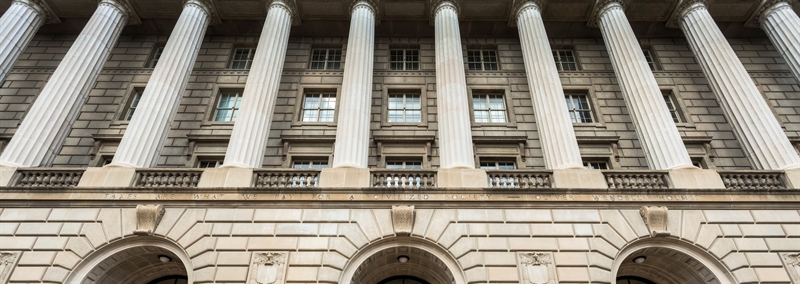
1111 Constitution Avenue
Schumer, Wyden and Warren Send Letters Regarding IRS CEO Position: On Oct. 28, Minority Leader Chuck Schumer (D-NY), Senate Finance Committee (SFC) Ranking Member Ron Wyden (D-OR) and Sen. Elizabeth Warren (D-MA) sent letters to Treasury Secretary Scott Bessent and Social Security Administrator Frank Bisignano regarding the new chief executive officer position at the Internal Revenue Service (IRS). In the letter to Commissioner Bisignano, the senators expressed concerns regarding the legality of his dual role as Social Security Administration (SSA) commissioner and the newly created chief executive officer (CEO) of the IRS. They questioned the statutory authority for the IRS CEO position, noting that it bypasses Senate confirmation and raised doubts about his capacity to manage two large federal agencies effectively, especially as they are headquartered in different cities amid significant workforce reductions and operational challenges.
In the letter to Secretary Bessent, the senators raised legal and operational concerns about the appointment of Commissioner Bisignano as “Chief Executive Officer” of the IRS. They argue that this dual role conflicts with Bisignano’s existing duties at the SSA and undermines the need for a full-time, Senate-confirmed IRS commissioner, especially ahead of the 2026 filing season. They questioned the legal basis for delegating IRS commissioner duties to Commissioner Bisignano, the compliance of this arrangement with the Federal Vacancies Reform Act, potential conflicts of interest given ongoing SSA-IRS litigation and requested detailed explanations of the delegation of authority and oversight mechanisms.
Taxpayers Revive IRS Dispute Resolution Program: Last year, the Internal Revenue Service (IRS) expanded its alternative dispute resolution (ADR) resources to encourage taxpayers to resolve disputes before litigation. Recently, the programs saw a 25% increase in usage by companies and individuals in fiscal year (FY) 2024 and is maintaining that upturn in FY2025. In early October, the IRS announced modifications to its post-appeals mediation (PAM) program, now assigning unresolved cases to Office of Appeals teams with no prior involvement in the case for an expedited, unbiased review. Earlier this year, the IRS relaxed eligibility rules for its Fast Track Settlement program, allowing cases with some ineligible issues still to participate and enabling more taxpayers, especially small businesses/self-employed, to join after points at which such cases have traditionally been excluded from the program, for example, the issuance of a 30-day letter or filing a protest with the Office of Appeals.
ERC Claim Processing Impacted by Government Shutdown: The shutdown is worsening existing difficulties that taxpayers face in claiming the Employee Retention Credit (ERC) for businesses. Thousands of ERC claims remain unprocessed due to a significant IRS backlog that existed even before the shutdown. The shutdown has forced the IRS to reduce staff by roughly half, paused appeals conferences and shuttered the Taxpayer Advocate Service, which normally assists with administrative issues, leaving taxpayers with fewer resources to resolve problems. Meanwhile, a two-year statutory deadline for filing refund suits looms and delayed appeals scheduling risks causing taxpayers to miss critical deadlines.

Tax Worldview
SCOTUS to Decide Scope of IEEPA Powers: This morning, the U.S. Supreme Court began oral arguments in a landmark case challenging the legality of tariffs imposed by President Trump under the International Emergency Economic Powers Act (IEEPA). The court will consider whether IEEPA grants the president authority to impose broad tariffs without explicit congressional approval and whether that delegation of power is constitutional under the non-delegation and major questions doctrines. The ruling could significantly affect the scope of executive authority, the separation of powers and future use of emergency economic powers. Oral arguments are scheduled for Nov. 5.
EU Countries Raise Concerns Over U.S. Global Tax Deal: Last week, the United States reportedly moved closer to a deal on coexistence with the OECD’s Pillar Two framework. Some EU countries, including Hungary and Estonia, have voiced skepticism, expressing concern that the United States might undercut Europe’s tax regime. Although the framework is intended to curb harmful tax practices and ensure multinational corporations pay a sufficient amount of tax, negotiations over U.S. exemptions risk weakening international support. OECD officials remain hopeful that a “side-by-side system” could preserve U.S. participation, but the path to a final agreement remains uncertain.
French DST Proposal Draws More Backlash from Congress: Last week, French lawmakers approved an amendment to increase the digital services tax on American technology companies from 3% to 6%. Sen. Thom Tillis (R-NC), a member of the Senate Finance Committee, criticized the measure and warned that the United States must respond with consequences, arguing that the tax disproportionately targets U.S. digital platforms. The move signals a potential escalation in trade tensions between the two nations, especially as the EU continues to finalize a broad-based trade agreement with the United States.
Asia Trade Deals Include DST Concessions: Last week, the Trump administration signed new trade agreements and frameworks with several Asian countries, including Cambodia, Malaysia and Thailand. The deals signal a shift toward addressing digital services taxes (DSTs) through trade agreements rather than traditional tax treaties. Cambodia and Malaysia committed not to impose DSTs or discriminatory taxes on U.S. firms, while Thailand agreed to refrain from adopting such measures. For more details, see here for Brownstein’s client alert.
Hearings and Events
House Ways and Means Committee
The House is out of session this week.
Senate Finance Committee
The Senate Finance Committee does not have any hearings scheduled for this week.