

Legislative Landscape
Shutdown Outlook Week 3: The federal government shutdown that began on Oct. 1 continues without resolution, as the Senate remains unable to pass a continuing resolution (CR) to fund the operations of the government. The stalemate continues to be disagreement over extending enhanced Affordable Care Act (ACA) subsidies. Bipartisan discussions are slow-moving, with a small group of senators negotiating potential reforms to reduce costs and prevent fraud. House Republican leadership, led by Speaker Mike Johnson, has kept the House in recess until the Senate passes the House-approved CR extending government funding until Nov. 21, 2025. Virtually everyone recognizes the importance of President Trump engaging on this matter.
Both parties believe they are prevailing in the ongoing shutdown standoff. Republicans emphasize that maintaining a firm position funding the government is the essential predicate to any negotiation on the ACA extension, with the furloughs of federal employees serving as leverage. On the other side of the aisle, Democrats stress the importance of including ACA subsidy extensions within the funding legislation, citing concerns over potentially significant premium increases if subsidies lapse.
On the agency side, the Office of Management and Budget (OMB) Director Russ Vought announced that reduction-in-force (RIF) notices began going out across multiple federal agencies on Oct. 10. Unlike previous government shutdowns, which primarily involved temporary furloughs, this shutdown has led to actual layoffs. According to recent court filings in a lawsuit by the American Federation of Government Employees (AFGE), the Treasury Department has laid off 1,446 employees. It is not yet evident whether these workforce reductions will pose challenges for the upcoming 2026 tax filing season and implementation of the One Big Beautiful Bill Act (OBBBA).
Military employees are expected to receive their Oct. 15 paychecks after President Trump instructed the Department of War to relocate approximately $8 billion in previously unused Pentagon research and development funds. The temporary maneuver applies only to military pay and will not extend to other federal civilian employees.
Tax Writers Enter the Blockchain Discussion: Republican lawmakers on the House Ways and Means and Senate Finance committees are working to develop legislation to update tax rules for digital assets. Although the effort is still in its initial stages, tax writers are working towards a bipartisan framework that could gain broader support in Congress. Prior to the recent Senate Finance Committee hearing on digital asset tax, the Joint Committee on Taxation (JCT) issued a pamphlet highlighting potential topics for consideration, including mark-to-market taxation, wash-sale rules, and establishing a de minimis threshold for taxing small cryptocurrency transactions. In July, Sen. Cynthia Lummis (R-WY) released her proposed framework that addresses the tax treatment of digital asset lending agreements, exclusion of de minimis gains on sales or exchanges, wash sales, market-to-market election, mining and staking. Rep. Max Miller (R-OH) is also expected to release his framework in the coming weeks, which is expected to follow the Lummis framework as well as address the tax treatment of digital assets involved in charitable contributions, airdrops, lending agreements and qualified retirement plans.
Markey Introduces the Stop Medical Profiteering and Theft (MPT) Act: On Oct. 8, Senate Health, Education, Labor, and Pensions (HELP) Ranking Member Bernie Sanders (I-VT), HELP Subcommittee on Primary Health and Retirement Security Ranking Member Ed Markey (D-MA) and Sen. Richard Blumenthal (D-CT) introduced the Stop Medical Profiteering and Theft (MPT) Act. The Stop MPT Act would limit the use of real estate investment trusts in health care and revise the current treatment of rents from qualified health care property.

Energy-Tax Mainlines
DOE Moves to Terminate Grant Funding for Clean Energy Projects: Last week, a list purporting to reflect proposed grant funding terminations by the Department of Energy (DOE) circulated through the clean-energy industry. The list included over 600 clean energy grants totaling more than $20 billion, including projects funded under the Biden administration’s initiatives, such as hydrogen hubs and direct air capture facilities. Initial cuts appeared to target predominantly Democratic-led states, but the expanded list reportedly includes significant projects in Republican-majority areas, including hydrogen hubs and carbon-capture programs backed by GOP lawmakers. DOE officials have not confirmed the authenticity of the list but noted that some projects are currently under “individualized” review.
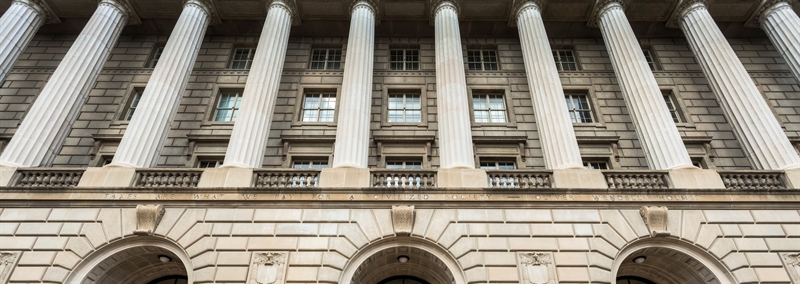
1111 Constitution Avenue
IRS Modifies Tax Brackets and Sets Inflations Adjustments: On Oct. 9, the Internal Revenue Service (IRS) issued Revenue Procedure 2025-32, which adjusts the 2026 income tax brackets for inflation as well as changes enacted in the OBBBA. While the tax rates remain unchanged, ranging from 10% to 37%, the income thresholds for each bracket increased, which allows taxpayers to earn more before being subject to higher marginal tax rates. The standard deduction also increased to $16,100 for single filers and $32,200 for married couples filing jointly. The Revenue Procedure also adjusted a range of other provisions as required annually under current law.
Neal Writes Acting IRS Commissioner Bessent on 2025 Filing Season Concerns: On Oct. 8, House Ways and Means Ranking Member Richard Neal (D-MA) sent a letter to Acting IRS Commissioner Scott Bessent asking him to ensure the 2026 tax filing season opens on time, warning that a delay until mid-February or later would postpone millions of refunds and affect families facing high tariff-related costs. Ranking Member Neal also requested responses regarding how recent IRS staffing cuts, budget reductions tied to Inflation Reduction Act (IRA) funding and limited resource limits will affect the 2026 filing start date, taxpayer call response times and refund processing speeds.
IRS Issues Interim Guidance on Partnership Designations: The IRS issued interim guidance effective Oct. 7, 2025, on the designation procedures for partnership representatives (PR) under the Bipartisan Budget Act of 2015 audit regime. A partnership must designate a single PR on each return filed for tax years beginning after Dec. 31, 2017, who has sole authority to act on behalf of the partnership in audit proceedings. The PR can be an individual or entity with substantial U.S. presence. The guidance provides that IRS Form 8979 should be used for designations and resignations, clarifies handling of multiple designations within a 90-day period, and specifies IRS examiner responsibilities.

Tax Worldview
EU Countries Weigh Extension of U.S. Carve-Out to Global Minimum Tax: Last week, Ioanna Mitroyanni, the European Commission’s deputy head of unit for company tax initiatives, spoke at a conference in Lisbon about the ongoing debates on the global minimum tax agreement. She noted that countries have yet to decide whether universal eligibility criteria for the “side-by-side” system proposed by the Trump administration will be developed or if the system will apply exclusively to U.S.-headquartered companies. Mitroyanni discussed the continuing negotiations over carve-outs for U.S. companies and emphasized the potential challenges of extending exemptions to other countries. Treasury Department officials continue to aim for the adoption of a side-by-side system to address the United States’ concerns with the global minimum tax by the end of the year.
Rubio, Wright and Duffy Issue Statement on the IMO Net-Zero Framework: In a joint statement on Oct. 10, Secretary of State Marco Rubio, Secretary of Energy Chris Wright and Secretary of Transportation Sean Duffy announced the United States’ unequivocal opposition to the International Maritime Organization’s (IMO) proposed Net-Zero Framework (NZF). The NZF aims to reduce global carbon dioxide emissions from international shipping by introducing a global carbon tax on shipping. They emphasized that the Trump administration rejects any international environmental agreement that unfairly burdens the U.S. economy and warned that the NZF could increase global shipping costs by 10% or more, adversely affecting American consumers, energy providers, shipping companies and tourists. The joint statement also outlined potential retaliatory measures against countries supporting the NZF, including port restrictions on vessels, visa limitations and increased fees for foreign maritime crews, commercial penalties related to U.S. government contracts, additional port fees, and sanctions targeting officials and organizations advancing the proposal.
OECD Reviews Transfer Pricing Guidelines: The Organisation for Economic Co-operation and Development (OECD) is reviewing its Transfer Pricing Guidelines to clarify and simplify existing rules in order to minimize disputes and mutual agreement procedures (MAP) between tax authorities. The review will focus on improving methods for determining comparable ranges, applying comparability adjustments, segmenting business units or regions, and intra-group services. The OECD also intends to develop guidance on pricing high value-added services, such as cloud computing. A consultation document outlining the proposed changes is expected by spring 2026.
At A Glance
CBO Estimates $453 Billion Drop in Corporate Tax Revenue Post-OBBBA: On Oct. 8, the Congressional Budget Office (CBO) released its “Monthly Budget Review: September 2025,” estimating a federal budget deficit of $1.8 trillion for fiscal year 2025. The report noted that corporate income tax receipts fell by $77 billion, or 15%, from $530 billion in fiscal year 2024 to $453 billion in fiscal year 2025. According to the CBO, the decline primarily reflected provisions in OBBBA that expanded deductions for certain investments, along with timing shifts that moved some corporate tax payments from fiscal year 2023 into fiscal year 2024. Overall, total revenues rose 6%, supported by increases in tariff revenue and individual income and payroll taxes.
Court Finds IRS Standards for 501(c)(4) Political Activity Unconstitutionally Vague: On Sept. 30, 2025, the U.S. District Court for the District of Columbia ruled in Freedom Path, Inc. v. Internal Revenue Service that the IRS standards for determining whether a 501(c)(4) organization engaged in excessive political campaign activity are unconstitutionally vague. The court found that the IRS’ multi-factor, “facts and circumstances” test lacks clear definitions on how much political activity is permissible or what counts as political activity, resulting in inconsistent enforcement. While the court partly granted Freedom Path’s motion for summary judgment on this issue, it did not grant the organization tax-exempt status because neither party proposed a constitutionally sound alternative standard grounded in existing law. The court ordered both parties to submit new standards that are clear, constitutional and based on existing statutes and regulations. To read more about the ruling, see here for Brownstein’s analysis.
U.S. Deficit-to-GDP Ratio Declines: At the Federal Reserve Board Community Bank Conference on Oct. 9, Treasury Secretary Scott Bessent highlighted that the U.S. deficit-to-GDP ratio has declined to under 6%, specifically to 5.9% for fiscal year 2025, down from 6.4% in 2024. Despite a roughly unchanged budget deficit of $1.8 trillion, driven by increased government spending and corporate tax cuts reducing revenue, heightened tariff revenues have helped offset the gap. Bessent emphasized his goal of further reducing the deficit ratio to the low-3% range by the end of Trump’s second term. He also noted tax code changes under OBBBA are expected to increase tax refunds for lower-income Americans in 2026, boosting real take-home pay for the bottom half of earners. Interest on federal debt surpassed $1 trillion yearly for the first time in 2025, representing a significant expenditure challenge.
IRS Issues Guidance on Remittance Tax Penalty Relief: On Oct.7, the IRS issued guidance for the 1% excise tax on remittance transfers in the OBBBA. Notice 2025-55 provides limited relief for the first, second and third calendar quarters of 2026, allowing providers to avoid penalties if they make timely deposits, even if calculated incorrectly, and pay any underpayment in full by the due date of the quarterly IRS Form 720 filing. Additionally, providers’ ability to use the deposit safe harbor rules under IRS excise tax procedural regulations will not be affected by deposit failures during this transition period, provided they meet the reasonable cause standard.
Hearings and Events
House Ways and Means Committee
The House is out of session this week.
Senate Finance Committee
The Senate Finance Committee does not have any hearings scheduled for next week.