

Legislative Lowdown
Smith Expresses Optimism for Year-End Tax Package While Wyden Remains Unsatisfied. Speaking at an event on Sept. 20, House Ways and Means Committee Chair Jason Smith (R-MO) expressed optimism and hope that a bipartisan tax package could eventually make its way to President Biden’s desk by the end of the year, citing the ongoing conversations he has had with Senate Finance Committee Chair Ron Wyden (D-OR). Chair Smith stated that the expired or soon-expiring tax extenders from the Tax Cuts and Jobs Act (Pub. L. 115-97)—namely the research and development amortization deduction, bonus depreciation and the net interest expensing deduction—are bipartisan and crucial to businesses. He also noted that the American Families and Jobs Act reported out by the Ways and Means Committee in a June markup includes these provisions. Smith mentioned the potential inclusion of a rum “cover-over” tax provision in a future package. Smith also sees common ground on potential non-extender tax credits, such as housing tax credits and the Child Tax Credit, which Wyden supports.
Wyden, however, remains apprehensive about Smith’s claims of bipartisanship: he believes the American Families and Jobs Act has disproportionately negative effects on working-class taxpayers compared to businesses. He has called that act “a tax break to businesses” and stated that an equal level of tax relief for businesses and families is his “key principle.”
Shutdown State of Play. Congress continues to barrel toward a shutdown, and the two chambers have embarked on different strategies to address it. The House is attempting to line up as many as six Fiscal Year 2024 spending bills in the next week, with Homeland Security, State-Foreign Operations, Agriculture-FDA and Defense on deck for a possible floor debate and Energy-Water and Interior-Environment still accepting amendments. However, none of these measures includes a continuing resolution (CR) or any stopgap funding measures, so even a full passage of one or more of these spending bills by both chambers would not prevent a shutdown. Commerce-Justice-Science and Labor-HHS-Education are resuming their markups this week.
In the Senate, Majority Leader Chuck Schumer (D-NY) released a temporary funding bill that would keep the government operating through Nov. 17. The bill allocates $6.1 billion in emergency funding for Ukraine, though it falls short of President Joe Biden’s request. The Senate bill also includes an extension of the Federal Aviation Administration’s (FAA) authorities through the end of the calendar year. Despite support in the Senate, this package will have trouble passing the House. House Speaker Kevin McCarthy (R-CA) faces animosity—and a threat to his speakership position—from his party’s right flank should he opt to take up a CR.

Tax Worldview
U.S. Treasury Secretary and UK Finance Minister Back EU Windfall Tax Plan on Frozen Russian Assets. On Sept. 20, Treasury Secretary Janet Yellen announced her support for a European Union (EU) plan to impose a windfall tax on profits generated by Russian sovereign assets that are currently frozen due to Russia’s ongoing military invasion of Ukraine. The revenue generated by the proposed tax, according to the EU plan, would contribute toward Ukraine’s reconstruction of areas damaged by Russia’s invasion. Secretary Yellen stated that the proposal was “reasonable” and indicated that a windfall tax is a sensible alternative to total asset seizure, which she previously argued would be illegal under U.S. law. However, the legality of asset seizure is in dispute. Several lawmakers and legal experts have proposed that Congress should pass a law seizing Russian assets and have also called on President Biden to use his emergency powers to do so.
Chancellor of the Exchequer Jeremy Hunt, the UK finance minister, agreed with Yellen that a windfall tax could be a viable course of action. Hunt has previously stressed that Russia should bear the costs of Ukrainian reconstruction efforts and that “the most interesting discussions are really about how to use the interest income generated by [frozen] assets to go towards that reconstruction without actually seizing the assets themselves.” EU officials, such as Belgian Prime Minister Alexander de Croo, previously estimated that the windfall profit tax could provide up to $3.27 billion per year to help rebuild Ukraine.
Senior Treasury Official Urges UN to Avoid Impeding the OECD Tax Deal. On Sept. 20, Treasury Deputy Assistant Secretary for International Tax Affairs Michael Plowgian called on the United Nations (UN) to avoid influencing the Organisation for Economic Co-Operation and Development’s (OECD) efforts to broker a global, two-pillar tax deal. He argued that Pillar One’s sourcing rules as well as Pillar Two’s subject-to-tax and Amount B provisions show that the OECD has taken the interests of “small developing countries” into account. One of the UN’s chief criticisms over the OECD’s efforts with respect to tax issues is the perceived disadvantage of developing countries in the ongoing negotiations. He also said that the OECD’s leadership structure better supports the end goal of “restabiliz[ing] the international tax system” compared to the UN’s majority-rule structure.
U.S. Lawmakers and Trade Officials Criticize Canada’s DST Push. On Sept. 19, a bipartisan group of House Ways and Means Committee members, led by Reps. Bill Pascrell (D-NJ), Beth Van Duyne (R-TX), Suzan DelBene (D-WA) and Darin LaHood (R-IL), wrote a letter to U.S. Trade Representative Katherine Tai, Treasury Secretary Janet Yellen and Chargé d’Affaires ad interim of the United States of America to the Organisation for Economic Co-operation and Development (OECD) Karen Enstrom, expressing disapproval of Canada’s drafted digital services tax (DST) set to take effect in 2024. The letter states that the DST, if implemented, “would seriously harm American companies and workers,” and requests that the agencies and organizations addressed provide an update by Oct. 3 on efforts they are taking “to ensure Canada does not enact a DST or any other discriminatory unilateral measure.” In addition, U.S. Deputy Trade Representative Jayme White met with Canada Deputy Minister for International Trade Rob Stewart on Sept. 20 to express continued concern with Canada’s DST plan and urged Canada to “redouble its commitment” to the OECD and delay their DST as negotiations continue.
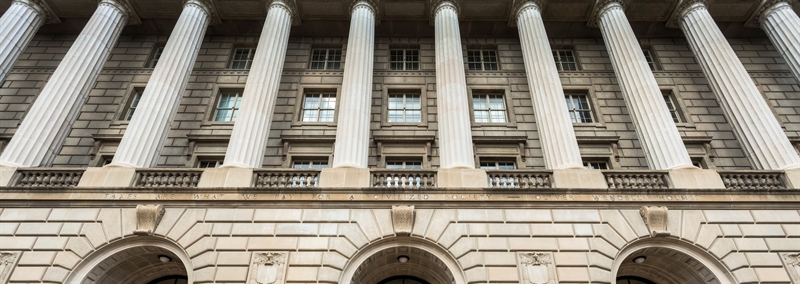
1111 Constitution Avenue
IRS Continues Efforts to Target Pass-Through Entities and Complex Partnerships. On Sept. 20, the Internal Revenue Service (IRS) issued Notice 2023-176, announcing that the agency would create a new unit housed within the Large Business and International (LB&I) division that would “focus on large or complex pass-through entities.” This announcement follows pronouncements made last week by the IRS that they would begin to devote more financial resources allocated by the Inflation Reduction Act (Pub. L. 117-169) to develop technology and increase audits on pass-through entities and large complex partnerships, and the agency’s plan to hire more than 3,700 individuals with experience in the financial services industry to work in this new division.
In the notice, IRS Commissioner Daniel Werfel stated that the creation of the new unit is a “part of our effort to ensure the IRS holds the nation’s wealthiest filers accountable to pay the full amount of what they owe,” and that noncompliance by wealthy filers and pass-through entities necessitates the need to create this new division. LB&I Commissioner Holly Paz clarified that the new group, along with the new hires, will also eventually pull from existing LB&I employees as well as employees in the Small Business/Self Employed Division to ensure an “efficient and effective transition.” Aiding in the transition, the IRS stated that they will also coordinate with the National Treasury Employees Union.
Along with efforts to ramp up audits on high earners, Commissioner Werfel stated in a letter to Senate Finance Committee Chair Ron Wyden (D-OR) that it will reduce correspondence audits of taxpayers claiming certain refundable credits such as the Earned Income Tax Credit, American Opportunity Tax Credit, Health Insurance Premium Tax Credit and Additional Child Tax Credit. These credits primarily benefit low- and middle-income taxpayers, and Werfel cited the IRS’s efforts toward “equitable and efficient tax administration” as a reason to reduce audits of taxpayers claiming these credits. The letter also cited other reasons, such as “achieving greater balance in our examination of different sources of non-compliance” and a recent Stanford University study finding substantially higher audit rates of Black taxpayers as a reason for their ongoing “rebalancing effort” that attempts to reconcile the audit rate disparities existing between low- to middle-income filers with high-income filers. Chair Wyden expressed approval for Werfel’s approach, stating that the IRS’s enforcement rebalancing effort “is exactly why Congress boosted funding for the IRS” and that he is “look[ing] forward to continued updates on the IRS’s progress in addressing … racial disparities."
At a Glance
Ways and Means Chair Questions U.S. Auto Manufacturers’ Partnerships with Foreign Companies. On Sept. 19, House Ways and Means Committee Chair Jason Smith (R-MO) wrote a letter to Treasury Secretary Janet Yellen requesting comment on whether certain electric vehicle production tax credits in the Inflation Reduction Act (Pub. L. 117-169) are inadvertently incentivizing certain U.S. auto manufacturers to partner with foreign companies with potential questionable ties to China and the Chinese Communist Party. In the letter, Chair Smith specifically questioned Ford’s partnership with the Chinese-owned battery manufacturer, Contemporary Amperex Technology Co. (CATL). He stated that, though the IRS and Treasury Department issued regulations seeking to prevent “foreign entities of concern” from claiming the IRA’s clean vehicle credits, the regulations do not adequately address the Ford-CATL partnership and whether CATL meets the definition of a foreign entity of concern. The letter asks the Treasury Department to respond to whether the department will release stronger guidance regarding foreign entities of concern, and whether they will reevaluate standards and audit processes to ensure that “taxpayer dollars do not flow to entities that are controlled by, or will benefit, foreign adversaries such as China.” The letter requests a response by Oct. 7.
IRS Continues Digitization Initiatives with New Hiring Announcements. As part of the IRS’s ongoing initiative to fully digitize the filing and processing of tax returns, the IRS Independent Office of Appeals announced that they were looking to hire roughly 450 appeals officers, settlement officers and appeals team case leaders. The office has said that it is seeking employees to fill job roles that were previously lost to attrition and retirements, and that the office is digitizing records because working from home has increased during and following the COVID-19 pandemic.
Brownstein Bookshelf
- Senate Republicans Probe IRS Over Destroyed Returns. On Sept. 21, Senate Finance Committee Ranking Member Mike Crapo (R-ID) joined all Finance Committee Republicans in writing a letter to IRS Commissioner Daniel Werfel regarding the IRS’s destruction of 30 million unprocessed Tax Year 2019 returns in March 2021. The letter urges the IRS to answer inquiries from a prior letter sent by Finance Committee Republicans in May 2022.
Hearings and Events
House Ways and Means Committee
The House Ways and Means Committee has no tax hearings scheduled for this week.
Senate Finance Committee
On Sept. 28, the Senate Finance Committee will host a hearing considering several nominations, including that of Marjorie A. Rollinson to be chief counsel for the Internal Revenue Service and assistant general counsel in the Department of the Treasury.