

Is Now the Time to File a Lawsuit for IEEPA Phase II Tariff Refunds?
The government’s June 12 statement on its appeal in the International Emergency Economic Powers Act (IEEPA) litigation means now might be the time.
The latest
In a series of interlocked cases, the government has been ordered to provide IEEPA refunds to all importers of record (IOR), whether or not they filed a case. This has been interpreted to require refunds beyond named plaintiffs, though the scope of that relief is currently being contested on appeal. There is a body of approximately 4,000 IORs who have filed individual suits in the Court of International Trade. Those suits have led to this order.
The government has started a process to do so (through CBP’s CAPE process). In that process, after receiving information from importers, the government generally focuses on entries that are not yet fully liquidated or are within the statutory protest/reliquidation window (often described as less than 81 days), and issues refunds. That is the “Phase I” CAPE process. Tariffs that are more than 80 days past liquidation (and some others) are not part of Phase I. Based solely on timing, we estimate that 20%‒30% or more of IEEPA tariffs are more than 80 days past liquidation.[1]
For tariffs more than 80 days past liquidation, the government has taken the position that it lacks clear statutory authority to issue such refunds absent a court order and that such a court order can only be issued for parties who have actually filed a lawsuit.
On June 12, the government filed a docketing statement discussing its appeal from the order, stating specifically that it was appealing the issue of “[w]hether the Court of International Trade erred in issuing a universal injunction requiring the government to refund tariffs.” This means that the government may argue that refunds outside of Phase I should be limited to parties who filed suit (referred to below as “Phase II” refunds).
Does this impact you?
- Companies with tariffs that became final more than 80 days ago cannot get those recoveries through a CAPE filing in Phase I. CAPE Phase I only allows recoveries for tariffs that are not final or became final less than 81 days before filing a CAPE declaration. If a company has IEEPA tariffs that are outside that window, the government’s action applies.
- If your company has paid significant tariffs that you are seeking to recover, filing a lawsuit soon may be your best course of action.
Another notable aspect of the government’s statement is that it is appealing the universal injunction generally, which includes the order as to refunds of Phase I tariffs. The process for seeking refunds of IEEPA tariffs has been extremely variable. It is possible that the government’s action will lead to changes in whether the CAPE process remains available to those who have not filed suit.
Thus, a decision tree for companies would be:
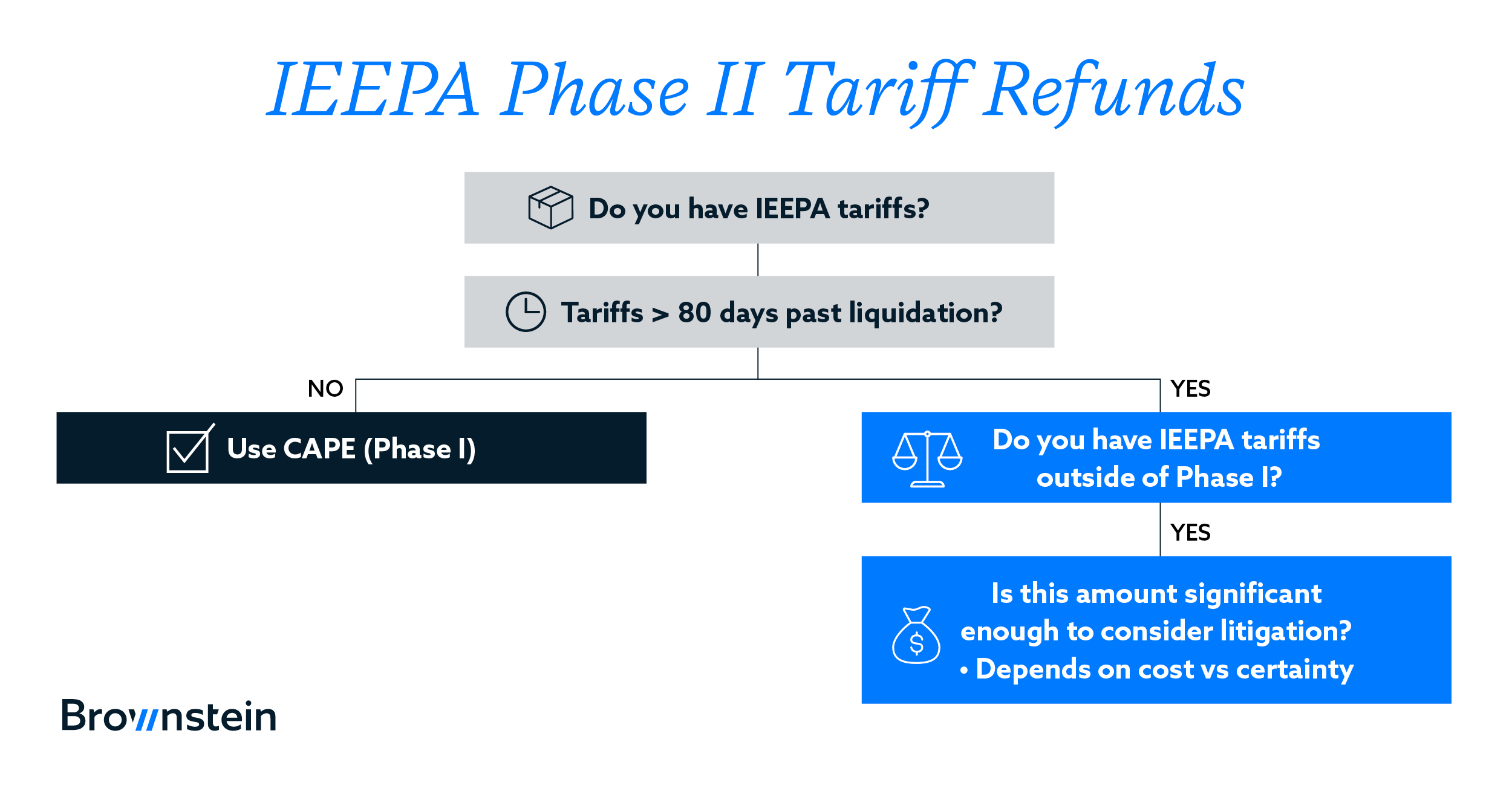
Should you act now?
The IEEPA tariff refund process is still not clearly defined and will not be until these issues are litigated and decided by an appellate court. It is fair to state, however, that if the government is successful, litigation may be the only viable path to recover Phase II amounts. Whether the door to filing a lawsuit will be open if that happens, what sort of waiting will be required, and what additional administrative burdens the court imposes are unknown. Accordingly, for companies that answer yes to the questions on the decision tree, it makes sense to file a lawsuit now.
In short, if you have tariffs that are more than 80 days past liquidation, and have not filed a lawsuit, you are unlikely to receive refunds under current administrative processes and may ultimately need to pursue litigation to preserve recovery.
[1] The percentage of tariffs that are more than 80 days past liquidation could be significantly higher. It depends on how many companies have filed under Phase I of the CAPE process already. This data is not yet publicly available.